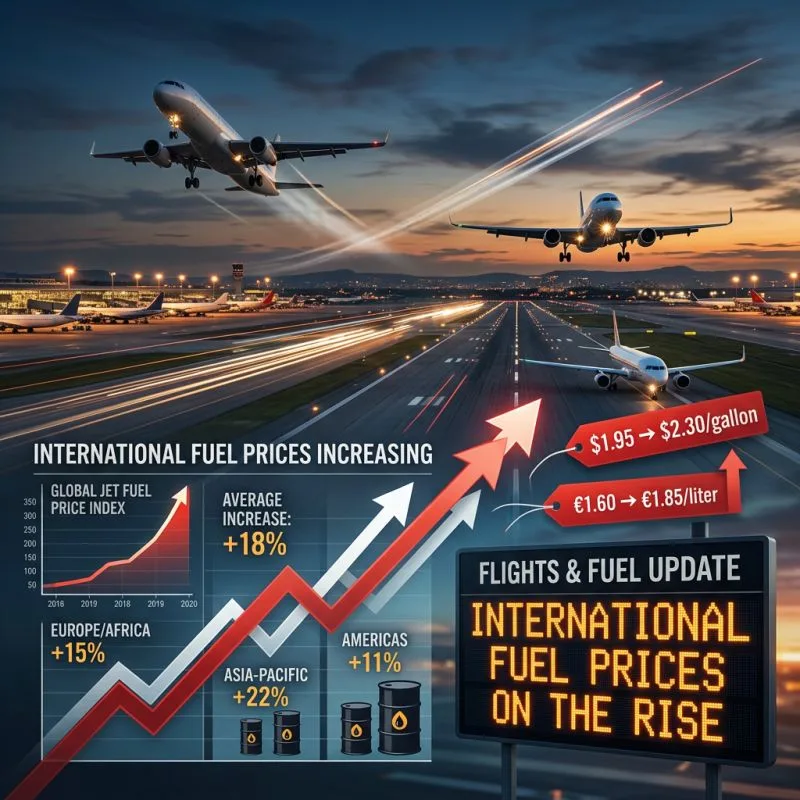
The fuel accounts for up to 40% of the operating expenses of an airline, second only to the labor costs that are borne by the airline.
With this ongoing Iran-US-Israel conflict, the global fuel prices have been skyrocketing from $85 to $200 per barrel. Adding to this, due to the ban on airspace in the Middle East, the flights are forced to take a longer flight path, which results in higher fuel consumption.

Let’s see how India’s airline markets are handling the situation
In India, the government has capped the aviation turbine fuel charges at 25%. In the international market, the capped rule does not apply. To comply with the directive and handle skyrocketing fuel prices, the Indian airline providers have moved towards tier-based charges rather than the flat fee model.
Indigo introduced new fuel charges starting April 2, 2026. The new rate applies:
- ₹275 for the flight up to 500 km
- ₹600 for the route spanning from 1,000 to 1,500 km
- up to ₹950 for the route over 2,000 km
For the long-haul international flight, subcharges range from as low as 900 to 10,000 per sector, depending on the distance.
Air India replaced its flat ₹399 domestic surcharge with a tiered structure, effective from the 8th of April, 2026:
- ₹299 up to 500 km
- ₹399 from 501 to 1000 km
- ₹549 from 1001 to 1500 km
- ₹749 from 1500 to 2000 km
- ₹899 above 2000 kms
And from the 10th of April, 2026, Air India international flights will have surcharges:
- SAARC: $24
- The Middle East: $50
- Europe: $205
- North America and Australia: $280

Other domestic players like Akasa Air have rolled out fuel charges ranging from ₹199 to ₹1,300, depending on the distance.
Despite these new charges, the industry experts believe that it won’t cover the exponential increase in international fuel prices and believe that these charges may increase in the near future.