Andhra Pradesh's state-owned drone corporation has signed a memorandum of understanding with Bengaluru startup Airbound to build a delivery network across the Amaravati capital region, with a stated target of 10,000 drone flights a day inside a year.
The agreement was signed Thursday in New Delhi, in front of Union Civil Aviation Minister Kinjarapu Ram Mohan Naidu himself an Andhra MP, Drone delivery in India lives or dies on regulatory clearance, and the man who controls that clearance was present.
The rollout begins in Guntur, not Amaravati
The project carries a working name, the Amaravati Capital Region Drone Delivery Network, and it starts small. Operations begin in Guntur before the network reaches across to Vijayawada and Amaravati. Airbound will run deliveries for partners in healthcare, logistics, and e-commerce, with a phased plan that runs through pilot flights, route mapping, regulatory coordination, and the slow build-out of connected drone corridors.
An MoU is not a contract. It commits both sides to intent, not tonnage. APDC managing director and chairman Geetanjali Sharma framed it as the foundation of a new logistics architecture for the state the language of ambition, signed before the first commercial parcel moves.
Airbound's drone is built around weight, not payload
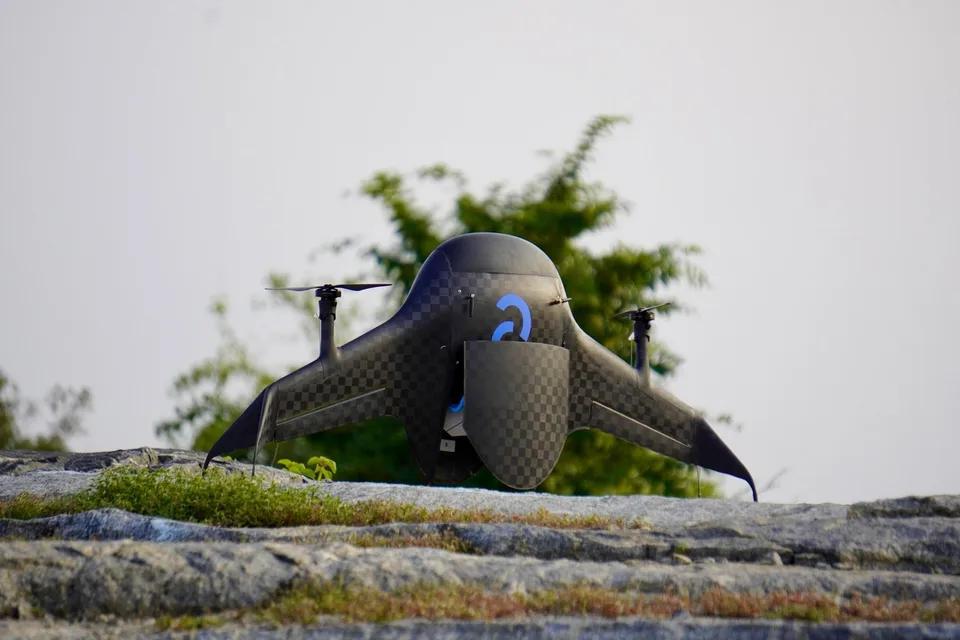
The aircraft is the TRT, a blended-wing-body tail-sitter built from carbon fibre, with two propellers. It launches vertically like a rocket and then flies like a plane, which lets it skip the runway and the helipad both.
It weighs 1.5 kg and carries about 1 kg. That payload ratio of roughly 1.5 to 1 is the whole pitch, against an industry norm closer to 4 to 1, and it gives the drone a range near 37 km. The battery is lithium-ion rather than the lighter lithium-polymer most drones use, because cell replacement is the single largest cost of running a fleet, and lithium-ion lasts several times longer per cell.
Naman Pushp founded the company in 2020, at fifteen, during the lockdown. He is twenty now. Airbound raised an $8.65 million seed last October, past $10 million in total, with backing from Lightspeed and Humba Ventures and a roster of senior people from Tesla, SpaceX, Anduril, and Ather.
Also Read: IIT Madras and FedEx successful Conducted India's first intra-city drone delivery trial in Bengaluru
The "20-tonne truck" line is about energy, not cargo
Pushp said the goal is to move single packages point to point "with the efficiency of a 20-ton truck." Taken literally, that is nonsense. A 1.5 kg aircraft lifting 1 kg is not a freight truck and never will be.
What he means is energy per kilometre. An electric two-wheeler in India weighs around 150 kg to carry a sub-3 kg parcel, and burns roughly ₹2 per km doing it. Strip out the rider and most of the vehicle mass and you cut the total weight in motion by about thirty times. Cut moving weight that far and the energy cost per km collapses toward 10 paise. The claim was never about capacity. It is that a tiny drone can reach the per-km economics that used to require moving things in bulk.
What this means for the 10,000-a-day target
The headline number deserves a closer look. Airbound has flown around 10,000 flights in its history. Cumulative, not daily. And it builds roughly one drone a day at its Bengaluru line.
Ten thousand flights every day needs a fleet in the hundreds at least, and beyond-visual-line-of-sight corridors approved across three districts. The company's own roadmap calls for 100-plus drones a day off the line and a million daily deliveries by mid-2027. So the binding limits here are factory throughput and DGCA corridor clearance, not the MoU's ambition. Healthcare leads for a reason: blood samples and diagnostics are low-volume, high-value, time-critical, and the regulator tolerates them. E-commerce is the volume that would ever justify 10,000 flights, and that math only closes once a delivery costs under ₹5.
India has run a version of this before. Zipline proved blood-on-demand by air in Rwanda years bblood on demandusted drones with parcels, and the order was always healthcare first,high-value, ander. Airbound is walking the same sequence. The airspace will open faster than usual this time, because a state corporation and a homegrown firm have the aviation minister's backing and a contained region to prove it in. So watch the Bengaluru line, not the press target. Tworksridors will be cleared before the factory can fill them.