China recovered the first stage of its Long March 10B rocket on July 10, catching the booster in a sea-based net on the vehicle's maiden flight, becoming only the second nation ever to retrieve an orbital-class booster.
The China Aerospace Science and Technology Corporation (CASC) confirmed the recovery about eleven minutes after liftoff from the Wenchang Commercial Space Launch Site on Hainan Island. An undisclosed satellite reached orbit, with full insertion confirmed more than 90 minutes later. What makes the flight matter is not that the booster came home. It is how it came home.
China took a different route home than SpaceX
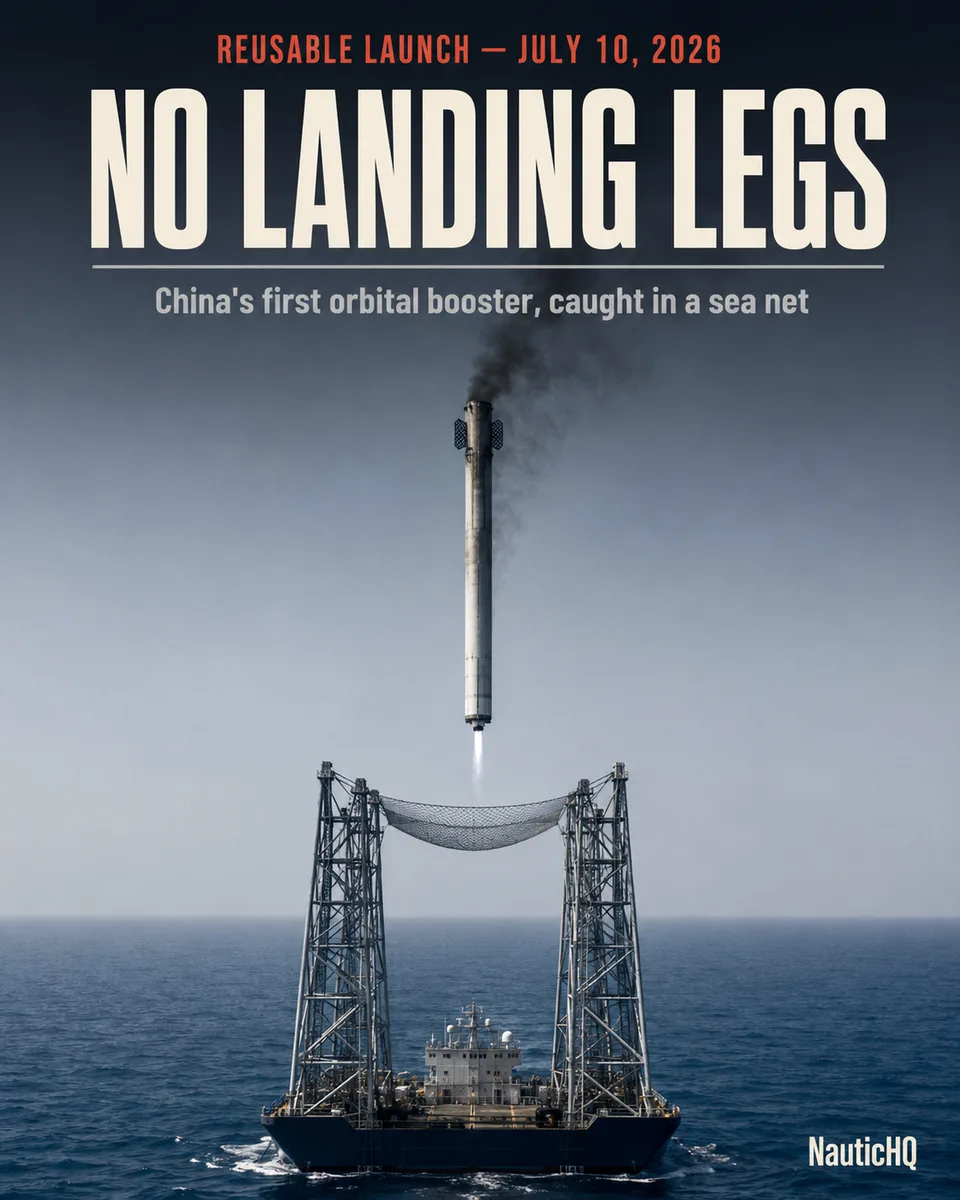
CASC brought the Long March 10B's first stage down into a net rather than onto landing legs, the first net-based recovery of an orbital-class booster anyone has flown. SpaceX's Falcon 9 and Blue Origin's New Glenn fly their boosters back under thrust and set them on legs, on a drone ship or a land pad. China moved that hardware off the rocket and onto the ship. The recovery vessel, the Linghangzhe ("Pathfinder"), runs 144 meters long and displaces 25,000 tonnes, holding position in open water with DP2 dynamic thrusters while a rig of tensioned cables arrests the descending stage.
The logic is a mass trade. Landing legs and their supporting structure ride all the way to stage separation and back, and every kilogram of recovery hardware bolted to the booster is a kilogram of payload it cannot lift. Strip the catching gear off the stage and put it on the ship, and the stage flies lighter. The Long March 10B carries 16 tonnes to low Earth orbit in this reusable configuration. The cost of the trade is precision: the booster now has to arrive exactly where a moving ship is sitting, on the open sea, with no legs to forgive an imperfect arrival.
The Long March 10B booster recovery puts China second, behind only the US
China is now the second country, after the United States, to recover an orbital-class rocket booster. SpaceX has landed Falcon 9 first stages more than 600 times since the first one stuck in December 2015, and in early July it flew a single booster for the 36th time, a reuse record. Blue Origin recovers its larger New Glenn boosters on a floating platform off the Florida coast. For scale, the Falcon 9 lifts up to 50,265 pounds to low orbit against the Long March 10B's 35,275 in reusable trim.
Every program calls its first recovery historic. The ones that change the economics are the tenth and the fiftieth, when the catch stops being news and becomes a line item.
Japan ran its own reusable-rocket test on July 11, a JAXA prototype that rose about ten meters and set back down at Noshiro. A hop, not an orbital flight, and a fair measure of how far ahead the two leaders now sit.
ALSO READ:SpaceX Pushes Falcon 9 Reuse to a 36th Flight
The rocket was built for the Moon, not just cheaper launches
The Long March 10B is the reusable variant of the vehicle China intends to use to land astronauts on the Moon before 2030. It stands 63 meters tall and five meters wide, with a liftoff mass of 760,000 kilograms. Seven liquid oxygen and kerosene engines power the first stage, a single liquid-oxygen and methane engine the upper stage. The China Academy of Launch Vehicle Technology, a CASC affiliate, built it.
The recovery ship was delivered in December 2025 and passed a sea splashdown test in February 2026 before the July 10 catch. That sequence reads as a program, not a one off.
The catch is the easy half. Reflying the stage is the half that proves the net-capture bet, and CASC has already scheduled that second flight before the end of 2026. Arresting a booster shows you can stop it. Flying it again shows the airframe and its seven engines came through the descent and the catch intact enough to certify without a teardown that costs more than building new which is exactly where [SpaceX's real advantage lives], not in the landing but in the fast, cheap turnaround after it. Watch two things through the back half of the year: whether the end of year refly holds its date, and whether China lays down a second recovery ship. One vessel recovers boosters. A cadence needs a fleet.