The A350-1000 price on the sheet is $366 million. In a deal, it is half that
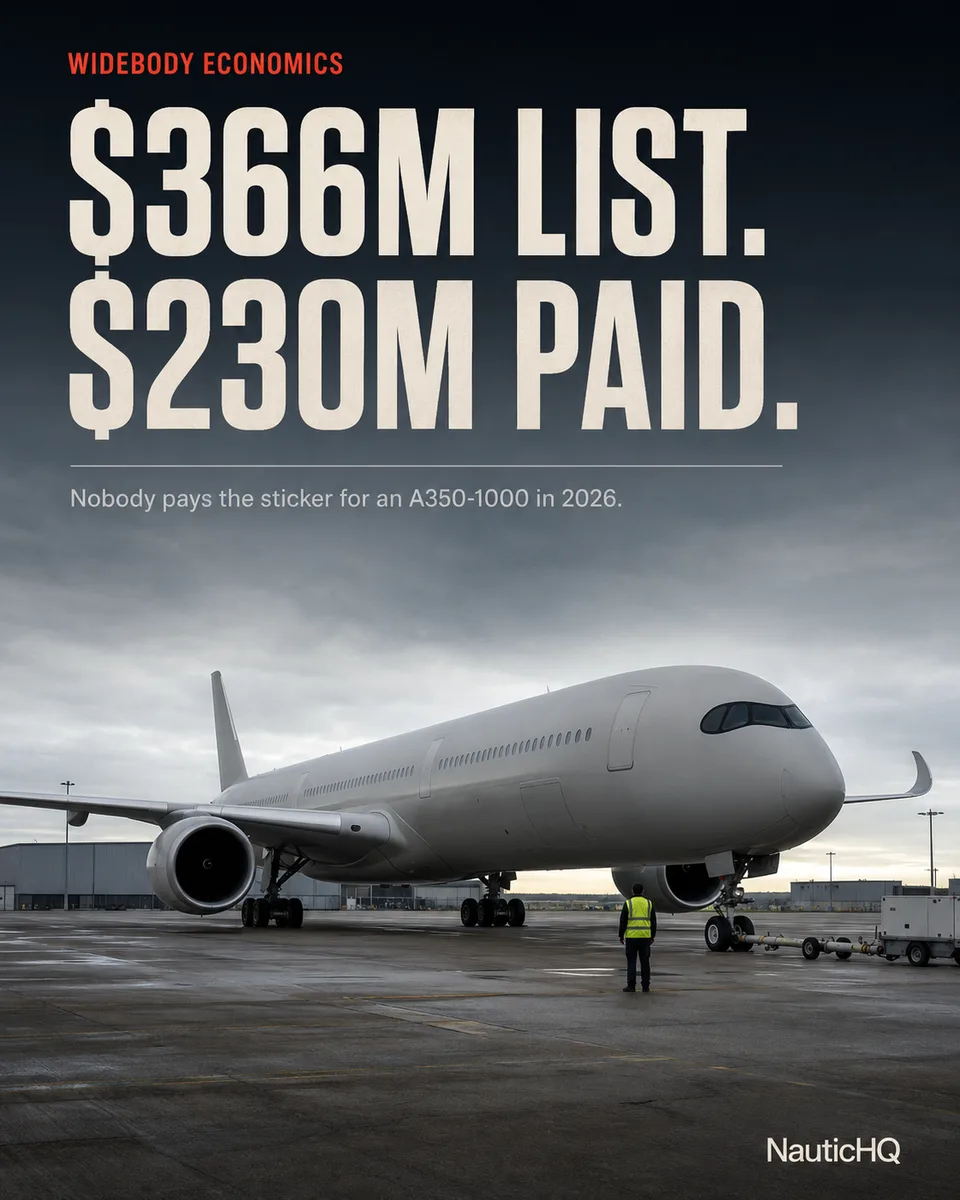
The A350-1000 price on Airbus's sheet reads $366 million. Real 2026 deals close between $180 million and $230 million, close to half off. The gap is where fleet economics get decided.
The published number and the paid number have drifted so far apart that the list price has stopped working as an analytical tool. In a supply-constrained widebody duopoly, the buyer sets the terms, and the discount is the story.
Airbus lists the A350-1000 at $366 million and expects no buyer to pay it
Airbus prices the A350-1000 at $366 million and builds its whole negotiation around no one paying it. The figure is a marketing anchor and the opening line of a bargaining process, not a transaction value. Order volume, contract timing, and how long the carrier and the manufacturer have done business together move the real number, case by case.
Real 2026 transaction data puts the paid price between $180 million and $230 million. That is a drop of close to half from the sticker, and for a carrier placing a bulk order it is the only number that matters. The list price exists to be discounted from, and reading an airline's capital spending off the sticker is how you misprice the whole fleet.
Airlines lean toward the larger variant because the revenue math rewards it. The stretched fuselage runs 242 feet (73.78 meters), which is more premium seats per departure on the dense long-haul routes where yield lives, and a lighter per-seat carbon load than the airframes it replaces. The standard A350-900 carries a slightly lower price point for carriers that want the family economics on thinner routes.
The airframe is not the final bill. Cabin work business-class suites, premium seating, the interior an airline actually flies adds tens of millions to a single delivery. Those suites get weighed against fuel burn over the hull's operating life, which is the calculation that justifies a carbon-composite twin-aisle over the older metal it retires.
Airbus discounts the A350-1000 to fill a decade of assembly slots
Airbus compresses its margin on the A350-1000 to secure production visibility, not out of generosity. A fleet-renewal commitment hands the manufacturer a filled assembly line for years out. A booked slot is a planned slot, a planned slot lets suppliers run steady, and steady suppliers cost less to run. The discount pays for itself in manufacturing stability before a single frame is delivered.
There is a second return that never shows on the airframe invoice. When a marquee network carrier commits, it validates the type for every planner watching, and that validation is worth more to Airbus than the margin it gives up to win the deal.
The discount also buys the airline hard arithmetic. The carbon composite airframe and current generation engines cut trip cost against the four engine widebodies these orders retire. Offered at half the list, the A350-1000 stops being a premium and starts being an upgrade a spreadsheet approves on its own.
ALSO READ: Gulfstream G800 Flies 8,303 nm,fastest business flight
Delta and Air Canada anchor the A350-1000 order book
Delta Air Lines has placed a firm order for 20 A350-1000s, with deliveries running from late 2026 into 2027, to retire its aging Boeing 767-300ER passenger fleet. Air Canada has committed to eight of the larger variant as a successor to its heavy Boeing 777-300ER and 777-200LR fleet, with those deliveries beginning in 2030. Air Canada is buying the type for reach 8,700 nautical miles (16,100 km) of range against its international map.
Both carriers are retiring aircraft the twin-aisle economics already condemned. Anyone who watched [the A380 and the 747 disappear]knows the pattern: four engines lost to two once extended-range twin-engine operations (ETOPS) and fuel math made the twin the obvious hull. The 767 and the 777-300ER are the next names on that list, and the A350-1000 is the replacement doing the retiring.
For Airbus, marquee orders keep the line booked into the 2030s. A filled back-order is insulation against a demand shock, because factory output holds steady even when the cycle turns.
Leasing shifts the residual value risk off the airline
Leasing lets a carrier fly a new A350-1000 without the capital hit of owning one. Current widebody lease rates put a new A350-1000 at $1.2 million to $1.4 million a month. The smaller A350-900 runs $900,000 to $1.2 million. The spread lets an airline match a fixed monthly cost to a specific route's yield.
The reason the lease exists is residual-value risk, and who carries it. An owned widebody is a 20 bet on what the hull is worth halfway through its life. Lease it, and the lessor takes that bet instead. The airline keeps its cash and its modern fleet and hands the depreciation guess to a firm whose entire business is making that guess. That is why leasing groups hold so much of the twin-aisle order book, and will keep holding it as long as the airline cycle stays volatile.
What this means for fleet planners and asset-value desks
The list price is finished as a valuation input. A planner or an asset value analyst who benchmarks off $366 million is benchmarking off theater. The working numbers are the transaction band and the secondary-market lease rate, and everything real gets priced there. A carrier that negotiates well inside a production cycle locks in a cost edge that runs for the life of the fleet, not the length of the deal.
The discount holds as long as the duopoly stays supply constrained and the buyers keep the pen, which is the setup right now and through the current delivery crunch. Watch the aftermarket. Airbus is compressing airframe margin on the bet that maintenance and service revenue earns it back over the hull's life, and if third party MRO margins thin out, the manufacturer's appetite to sell at half off thins with them. The sticker will keep drifting from the paid price until the service math, not the airframe math, forces the correction.
FAQ
What is the real 2026 transaction price of an Airbus A350-1000?
Real 2026 deals close between $180 million and $230 million, against a $366 million list price. Order size, contract timing, and the carrier's history with Airbus decide where in that band a given deal lands.
Why do airlines pay so much less than the A350-1000 list price?
The list price is a negotiating anchor, not a transaction value. Airbus discounts to lock in fleet-renewal commitments that fill its assembly line for years, and a marquee order also validates the type for the next buyer — both worth more than the margin given up.
What does it cost to lease an A350-1000 instead of buying?
A new A350-1000 leases for $1.2 million to $1.4 million a month, while the smaller A350-900 runs $900,000 to $1.2 million. Leasing preserves the airline's capital and moves the residual-value risk to the lessor.