Sarla Aviation has flown Sylla, its half-scale electric technology demonstrator, completing an integrated flight test campaign the Bengaluru company says took under twelve months from design to first flight.
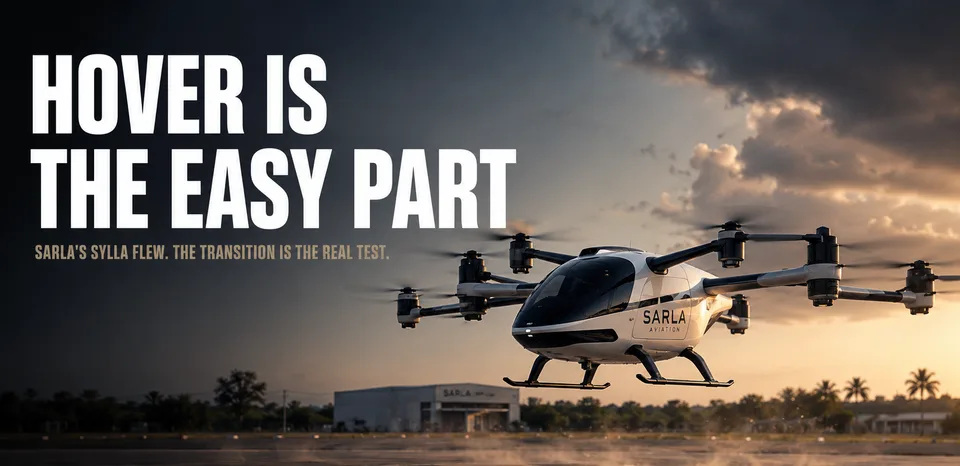
The startup, backed by Accel and Zerodha co-founder Nikhil Kamath, is building toward Shunya, a full-scale electric air taxi it has targeted for a 2028 launch into regional and urban air mobility. Sylla is the proving ground. With the southwest monsoon now over southern India, the flight campaign has closed and the program moves to its next demonstrator.
Sylla lifted off, hovered, and landed under its own control
The demonstrator lifted straight off the ground, held a hover under closed-loop control (the flight-control system stabilizing the aircraft on its own, without a tether or external correction) and repeated the cycle. Sarla says Sylla 1.0 hit the engineering targets it was built to hit.
That is a real result. It is also the part of electric vertical take-off and landing (eVTOL) flight that was least in doubt.
Hover is not the hard part
A multicopter hover is a well-understood controls problem. Enough rotors, a competent flight-control loop and adequate battery power will hold an airframe steady in the air. Helicopters have done it since the 1940s. The convertiplane idea, lift like a rotorcraft and cruise like an airplane, is older than the jet engine, and the reason it stayed on the drawing board for decades was never the hover.
It was the transition.
Moving from rotor-borne lift to wing-borne lift means changing the entire source of lift in mid-air, handing control authority from the rotors to the wing while airflow, power draw and pitch all shift at once. For a few seconds the aircraft is neither a helicopter nor an airplane, and the control laws have to manage the handoff cleanly. That is where eVTOL programs consume their capital, and where the schedules slip.
Sarla knows this. The company says its next demonstrator is being built specifically to achieve controlled transition from hover to sustained wing-borne flight, which is a precise way of saying Sylla 1.0 did not.
ALSO READ:IIT Madras and FedEx successful Conducted India's first intra-city drone delivery trial in Bengaluru
Three India firsts, all on the engineering side
Sarla lists the Sylla program as the first in India to build and fly a 700-kilogram-class electric aircraft capable of vertical take-off, the first to fly a 400-volt electric powertrain, and the first to demonstrate a distributed-propulsion wing system. It also claims the first full-stack ground testing done to airworthiness regulations in the country.
These are engineering firsts, and worth logging. None of them is a certification first, because that milestone does not exist to claim yet.
"Flying Sylla is the moment a thousand simulations become real," said Rakesh Gaonkar, co-founder and chief technology officer, adding that the company got there in under a year and on a fraction of the capital. The capital efficiency is the pitch. The certification bill is the part that has never been cheap for anyone.
What this means for the 2028 timeline
For anyone tracking the money, the investors and any operator thinking about ordering into this class, a hovering half-scale demonstrator sits a long way from a certified, crewed air taxi carrying paying passengers over a city.
The gating item is not flight testing. It is the certification basis. Crewed eVTOL has no settled type-certification standard anywhere in the world, and India's regulator has yet to publish one for the class. A demonstrator can fly on a startup's timeline. A type certificate moves on the regulator's.
Watch Sylla 2.0, because the transition it is being built to attempt, not the hover Sylla 1.0 already flew, is the real proof point. And watch the DGCA. The 2028 date rides on a certification basis that does not yet exist, and flight-test milestones have always moved faster than the rule-writing behind them. The flying will stay ahead of the paperwork. Whether the paperwork catches up by 2028 is the question the hover footage does not answer.