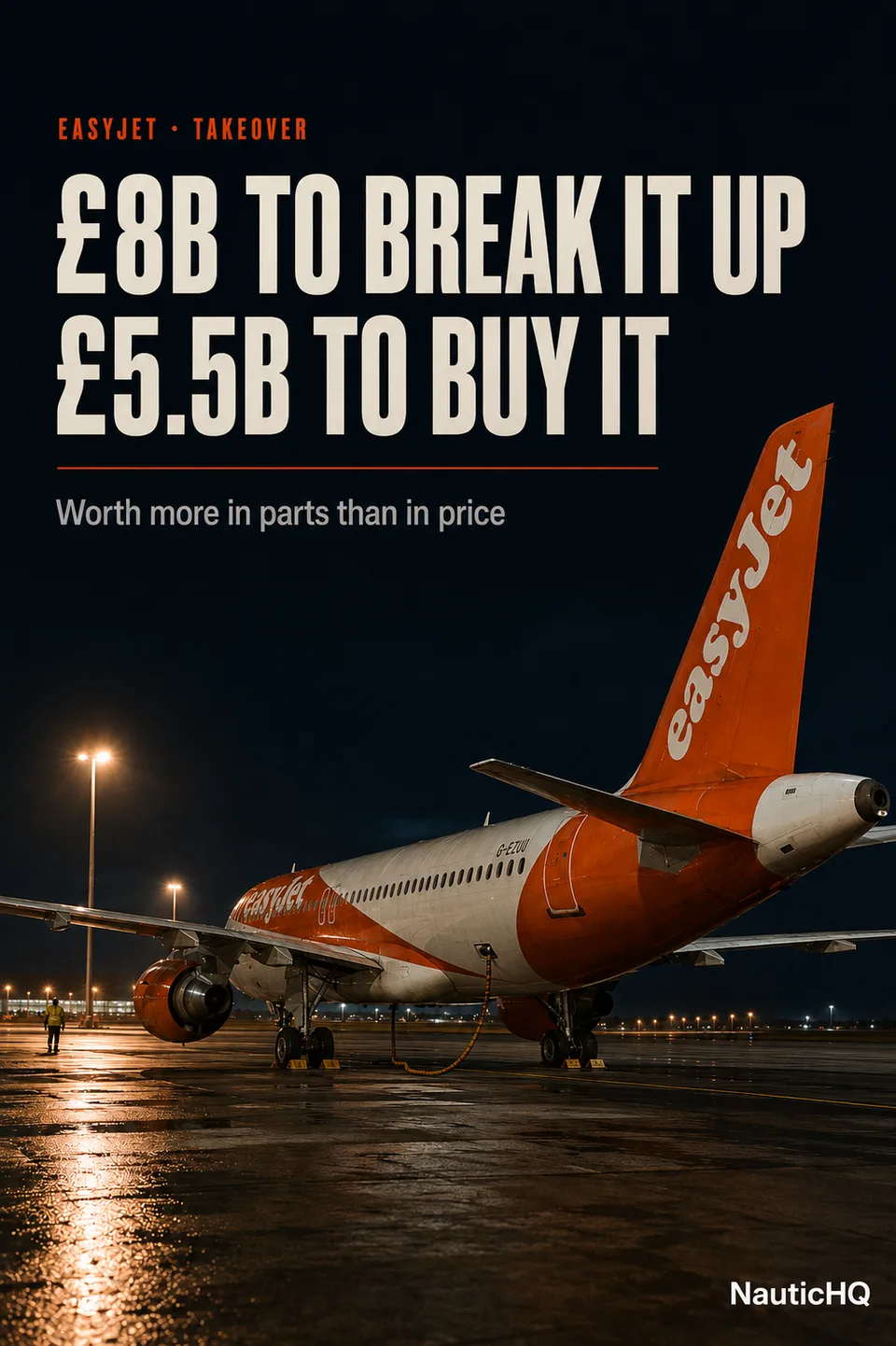
EasyJet's board has accepted a takeover from US investment firm Castlelake at £6.90 a share, valuing Europe's second largest low cost carrier at £5.5 billion, roughly $7.3 billion, and taking it private.
The deal is not done. It needs a shareholder vote, it needs regulatory clearance, and it needs a European co-owner that Castlelake does not yet formally have. What the board's yes does is set a price. After the same directors rejected offers that opened at £5.60 a share, £6.90 is now the number everyone else has to argue with.
The board said yes at £6.90. That is not the same as done.
Castlelake did not get here in one move. It came in low, at £5.60, and the board turned it down. It raised the offer, and kept raising, until the directors agreed in principle at £6.90. That is £5.5 billion for the equity, a little over $7.3 billion.
Three things still stand between the offer and a completed deal. The first is ownership. The second is the shareholders, who have not voted and who may decide the board settled too cheaply. The third is the regulator, which will want to know what a US financial buyer intends to do with an airline that carries tens of millions of Europeans a year, and whether that intent is good for the people in the seats.
Board approval is the start of this process. Not the end of it.
The break-up value sits above £8 billion, and that gap is the point
Here is the number that explains the bid. Analysts put EasyJet's break-up value, the fleet of aircraft plus its airport slots, above £8 billion. The offer on the table is £5.5 billion. The company's market value before all this was lower still.
An airline's share price tracks what the operating business earns, not what its hardware would fetch. EasyJet made around £500 million last year, and executives have promised to roughly double that in the coming years. The market prices that stream of profit, cyclical and thinner than Ryanair's, at £5.5 billion or so. The aircraft and the slots are worth more than that sold or redeployed. The public market will not pay for the liquidation value of an airline it expects to keep flying.
A private buyer can.
That is the whole thesis, and it is not unique to EasyJet. Every take-private of an asset heavy airline gets sold as a growth story and underwritten as an asset story. The question a serious reader should sit with is why the gap stayed in plain view for so long, and why Castlelake is the one acting on it rather than the dozens of funds that can read the same balance sheet.
A non-EU buyer cannot own EasyJet outright
The ownership rule is not a formality. A carrier with European flying rights has to be majority owned and controlled by European interests, or it loses those rights. Castlelake is American. It cannot simply buy EasyJet and hold it.
Its answer, so far, is that two Irish advisory businesses will take part in the deal to satisfy the requirement. Whether that structure is real control or a nameplate is exactly what a regulator exists to test. The last time ownership and control questions turned serious in Europe, they were not settled with a press release.
Castlelake has run this at SAS, with Air France-KLM alongside
Castlelake is not new to airlines. It took a stake of roughly one third in Scandinavian Airlines after that carrier's reorganization, and it did so in partnership with Air France-KLM.
That partnership is the tell. Air France-KLM's chief executive, Ben Smith, said several weeks ago that the group would be open to talking about investing in EasyJet, while making clear it was not part of a formal bid. The group already runs a low-cost arm in Transavia. EasyJet would hand it short-haul European reach on a scale Transavia cannot build from where it sits.
So why is Air France-KLM not simply bidding itself? Because it does not have to yet. Let the financial buyer take the ownership-structure fight and the regulatory risk first, then step in with the European stake once the path is cleared. That is not caution. That is sequencing.
ALSO READ:Rocket Lab to Buy Iridium for $8 Billion in Cash and Stock
What this means for asset value analysts and fleet planners
Strip the noise and the trade is the gap. Someone believes EasyJet's aircraft and slots are worth £8 billion-plus while its equity is being offered at £5.5 billion, and they intend to own the difference. The route to it is not, despite the speculation, shutting the airline down and parting it out. A regulator reviewing a takeover will not wave through a plan to delete Europe's second-largest low-cost brand and sell its metal. That version does not survive contact with the approval process.
The realistic route is quieter. Take the company private, unlock asset value the public market refused to price, and keep the airline flying, because the flying is what protects the slots and the brand that make the assets worth £8 billion in the first place. The gap closes through structure, not liquidation.
Watch two things. Watch the shareholder vote, because it decides whether £6.90 holds or the board has to find more. And watch who ends up as the European partner of record, because that name tells you whether this is a financial trade or the front end of an Air France-KLM consolidation play.
Strip the deal to its binding constraint and the next move is already visible. A non-EU buyer cannot hold a European carrier and keep its traffic rights, so Castlelake needs a European name on the register before regulators engage, and it has run exactly this structure once already, at SAS, with a partner that has now said out loud it is open to EasyJet. Expect the deal to converge toward the SAS template: Castlelake supplies the capital and absorbs the regulatory risk, a European carrier supplies the ownership qualification, and the most likely name on that line is the one already circling. If it rhymes with SAS, the talk of shutting EasyJet down answers itself.