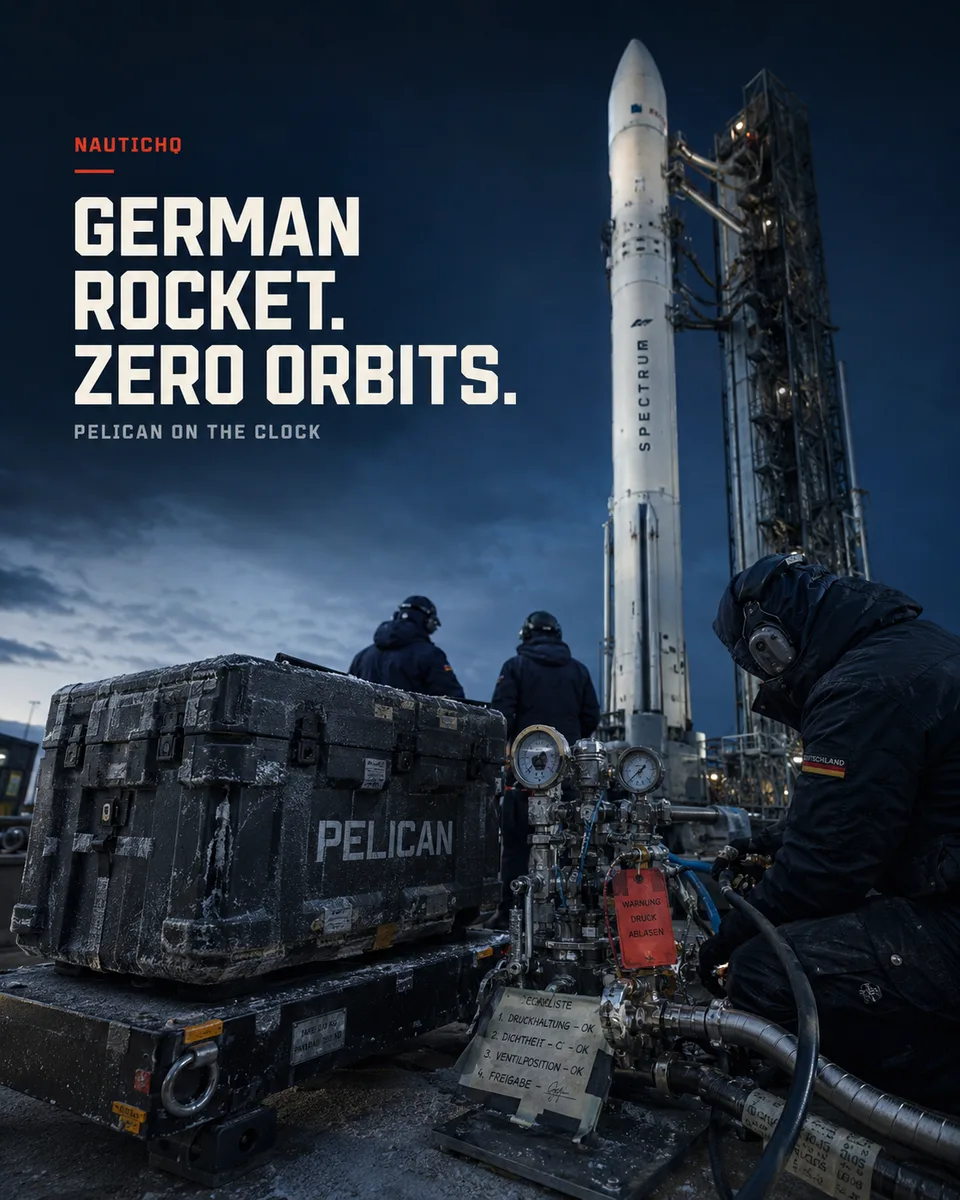
Isar Aerospace has signed Planet Labs Germany to launch a Pelican imaging satellite on its Spectrum rocket as early as late 2026, the first mission to fly both a satellite and a rocket built in Germany.
The deal, announced July 2, arrives inside a specific political window. Last September, Berlin set aside €35 billion ($40 billion) for military space over five years. Two companies are now planting a flag in that budget before it fully opens.
Both the satellite and the rocket wear a made-in-Germany label
The Pelican will be assembled at Planet's new manufacturing line in Berlin. The Spectrum rocket is built near Munich, where Isar runs a 40,000-square-meter factory and says it can eventually turn out 40 vehicles a year. Put the two together and you get the mission's whole selling point: a German payload on a German launcher, lifting off from European soil.
"Planet and Isar Aerospace are responding to the moment and delivering a first for the country," said Martin Polak, managing director of Planet Labs Germany. He tied the sub-12-month timeline to an "agile aerospace approach" aimed at national priorities across security, resilience, and civil use.
Sovereignty is the actual product here. Not the imagery. Europe has watched enough of its satellites ride American and, until recently, Russian rockets to treat a domestic launch chain as a strategic asset in its own right.
The rocket has reached orbit zero times
Here is the part the press release left out.
Spectrum has flown once. That flight, in March 2025, ended shortly after liftoff, brought down by a pressurization valve issue. The second attempt was meant for January, then slipped again and again. A range violation scrubbed a March try, and technical problems ate the rest of the spring. Isar lined up a fresh window for mid-June, then stood down hours before the June 15 attempt, citing "off-nominal behavior in the vehicle's fluid systems." As of the Planet announcement, no new launch date exists.
So the manifest now holds a paying customer's 200-kilogram satellite on a rocket that has yet to complete a single successful flight, under a contract that reads "within 12 months."
Every NewSpace launcher books its manifest before it books its first orbit. The signatures come easy. The second stage does not.
Pelican is the heaviest thing Planet flies
The Pelican line is Planet's high-resolution tasking fleet, and at roughly 200 kilograms each, these are the largest satellites the company currently operates. Moving that production to Berlin is a bet on scale: Planet expects to add up to 70 people to an existing team of about 150 in the city. The Isar contract carries options for further launches, which is where the real volume, if it comes, would sit.
For Planet, the logic is clean. A San Francisco parent (NYSE: PL) stands up a German subsidiary, builds a German factory, and hands a German launcher its highest-profile domestic payload. That is how you qualify for sovereign-space money that increasingly comes with a build-it-here condition attached.
What this means for launch buyers
For anyone procuring launch capacity in Europe, the signal is availability, not yet reliability. Isar has assembled a real manifest (the Norwegian Space Agency, R-Space, SEOPS, OroraTech, and now Planet), which tells you demand for a non-SpaceX, non-Arianespace European ride is genuine and largely unmet. What it does not yet tell you is cadence. A launcher's worth to a fleet operator is not its first orbit but its tenth, on schedule, at a quoted price.
The €35 billion behind German military space will forgive a delay. It will not forgive a vehicle that never proves itself.
The second flight decides the timeline
The fluid-system anomaly that scrubbed June is unresolved, and until Isar clears it and reaches orbit, the "late 2026" Pelican date is aspiration, not schedule. A launch slot is only as real as the flight that proves the vehicle, and Spectrum still has to reach orbit, fly again, then carry a customer. Three steps, none cleared, on a clock that started in July. If the next test flies clean, the Planet timeline is ambitious but plausible. If it doesn't, late 2026 becomes 2027, and the made-in-Germany milestone waits another year for the one thing no press release can supply a working rocket.