The US Air Force is replacing the B-52's eight engines with the Rolls-Royce F130, and the resulting B-52J will fly farther, cost less per hour, and outlast the B-1B Lancer built to replace it three decades later.
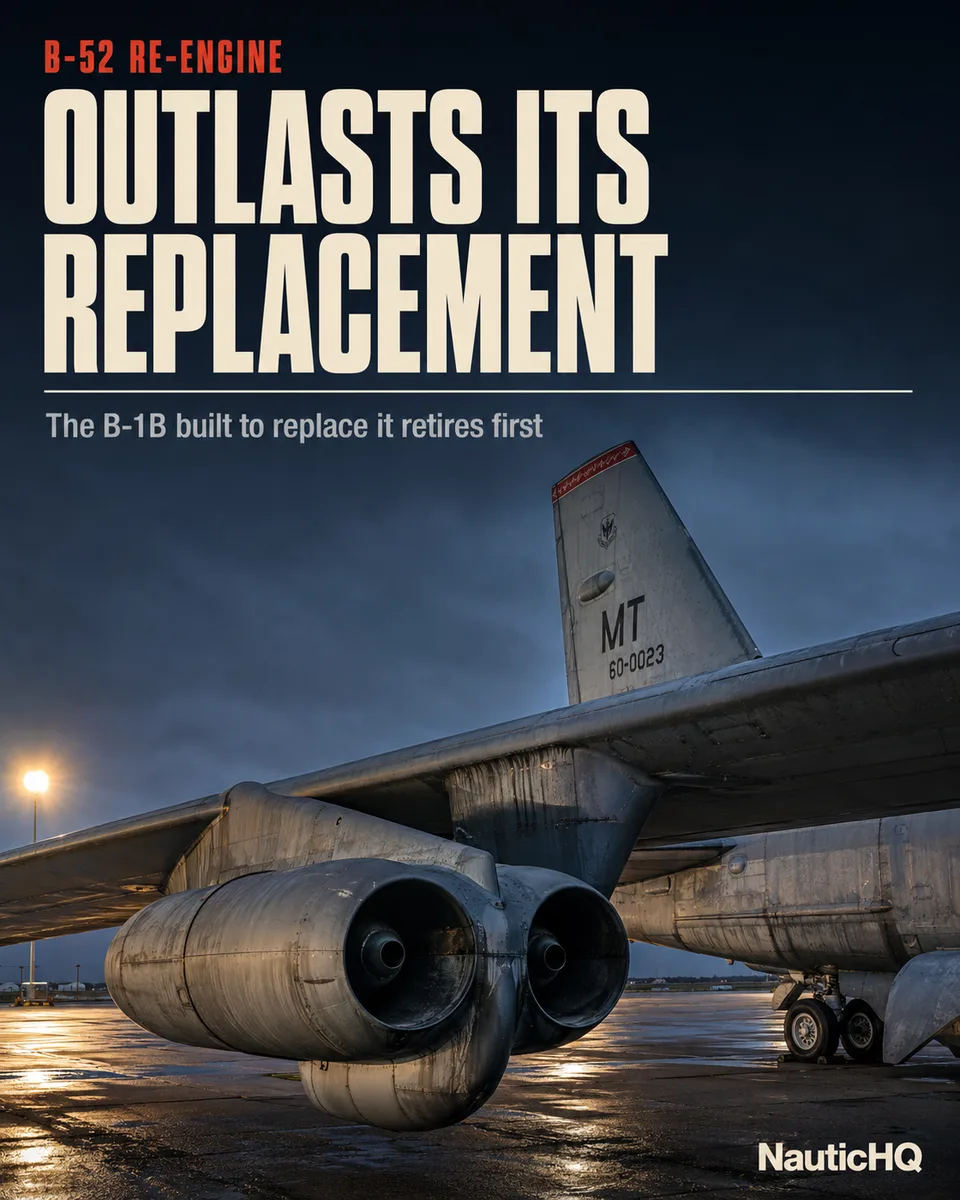
The Commercial Engine Replacement Program (CERP) cleared its Critical Design Review on May 4, 2026, the sign off on nacelles, pylons, electrical systems, and control software before any airframe goes under the wrench. All 76 aircraft are cleared for conversion. It is the largest single capability jump the B-52 has seen in six decades, and it comes entirely from the engines.
The TF33 is a 1962 engine the Air Force can no longer afford to feed
The Pratt & Whitney TF33-PW-103 that powers today's B-52H is a first-generation turbofan drawn up in the late 1950s, before high bypass ratios and before digital engine control existed. It entered service in 1962 and has run continuously since.
The production line closed in 1985.
That is the root of the problem. Every scheduled depot overhaul pulls the engine off the aircraft, ships it to a specialist shop, and holds it there for weeks against parts nobody makes anymore. The TF33 needs one of those overhauls every few thousand flight hours. The parts come from shrinking stockpiles or get custom machined at a premium, for an aircraft the Air Force means to fly another thirty years.
The starting problem is worse in the field. A TF33 will not spin up on its own. It wants an external pneumatic cart or an explosive cartridge starter, and that ground gear travels everywhere the aircraft does. The War Zone has called sustaining the engine increasingly costly and time consuming, and a squadron move shows the cost in plain terms: relocating B-52Hs has meant multiple C-17 flights carrying nothing but TF33 spares, tools, and hydraulics.
The F130 is a commercial engine with 27 million hours behind it
The Rolls-Royce F130 is the military designation for the commercial BR700, already flying on the Air Force's C-37 (its Gulfstream V transport) and the E-11A communications node. So the Air Force is not buying a clean-sheet engine. It is buying an existing parts pipeline, a trained maintenance base, and a track record: more than 27 million flight hours across the military and civil fleets, by Rolls-Royce's count.
Rolls-Royce sank over $600 million into its Indianapolis plant to build it, a dedicated line on US soil, and expects to deliver more than 600 units for the 76-aircraft fleet. Roughly 608 installed, about 100 spares in rotation.
One line in the requirement tells you how far apart the two engines sit. The F130 is specified to stay on the wing for the B-52J's entire remaining life with no scheduled midlife depot overhaul. Fit it in the early 2030s and it flies on that same airframe into the mid-2050s without ever coming off for a major shop visit. That is not a military wish bolted onto an old design. It is the central promise of a modern airline engine, time on wing as money, carried straight across to a bomber.
A 30% fuel cut rewrites the tanker math
The headline figure is 30%, the efficiency gain the Air Force wrote into the requirement and that independent sources agree the swap delivers. On a jet that already lifts up to 70,000 lb over an unrefueled range past 8,800 nautical miles at Mach 0.84, cutting fuel burn per unit of thrust by 30% is not a rounding gain. It takes roughly a quarter to a third off the fuel cost of every sortie and extends how far the aircraft reaches before it needs a tanker at all.
That last part matters more than it reads. Strip a refueling down to what it actually is: a fixed, predictable, vulnerable point in the sky that the bomber must reach on schedule. Every one the B-52J no longer needs is a KC-46 or KC-135 freed for other work, one fewer rendezvous the mission depends on, one variable gone from the route.
The F130 also throws off far more electrical power than the TF33. That is headroom the airframe needs for its AESA radar, its electronic warfare suite, and whatever directed-energy load the 2040s bring, without a separate power upgrade. Army Recognition frames the re-engining as the propulsion half of a broader modernisation pairing the F130 with digital avionics, Link 16, and expanded EW to carry cruise missiles and hypersonic weapons farther. The engine is what makes the range behind those claims real.
And the electric starters retire the pneumatic cart. Under Agile Combat Employment, the doctrine that scatters bombers off major bases onto rough forward strips, a B-52J can shut down and restart on basic field power. For the TF33 that ground-cart tail was a real limit on the concept. The F130 removes it.
ALSO READ:Gulfstream G800 Flies 8,303 nm,fastest business flight
Why a 1952 airframe outlasts the jets built to replace it
Here is the inversion. The B-1B entered service in 1986, the B-2 in 1997. Both are newer than the B-52 by decades, and both reach the boneyard first. The B-21 Raider inherits the B-2's penetrating stealth role. Nothing specifically inherits the B-1B's conventional heavy-strike mission, because the B-52J absorbs it at a fraction of the running cost.
The reason is structural. The B-52 flies a straight, thick, unswept wing that is simple to maintain and forgiving across a wide load range. The B-1B's variable-sweep geometry, built for low-level supersonic dash, turned out expensive to keep airworthy and prone to fatigue after decades of use its designers never modeled. It now burns between 74 and 150 maintenance hours for every hour aloft, the worst ratio in the bomber fleet. The B-2's stealth coatings demand climate-controlled hangars and a sustainment bill that has never landed on estimate.
The four-engine widebody died because two engines that could cross an ocean cost less to run than four. That arithmetic scrapped the passenger 747 and grounded the A380 early. The B-52 is that same logic running in reverse: re-engine the old airframe, reset its fuel math, and the aircraft built to succeed it becomes the pricier way to do the identical job.
The Air Force is scrapping its two newest bombers and re-engining its oldest. That is not sentiment. It is a spreadsheet.
What the fleet planner and the sustainment officer take from this
For anyone costing the 2030s bomber force, CERP changes the terms the B-52 competes on. It stops being the thirsty old airframe kept for payload and becomes the low-cost-per-hour standoff platform in a two-type fleet beside the B-21. The mission split is clean. The B-21 penetrates defended airspace. The B-52J launches AGM-181 LRSO, JASSM-ER, and in time hypersonic weapons from outside the threat ring, where stealth is not the requirement and payload is. Nothing flying or funded carries more standoff weapons farther on a single sortie.
For sustainment, the move is from a scarcity supply chain to a commercial one. Parts in production, an engine that stays on the wing, no cartridge starters, no C-17 loads of spares chasing every deployment. The whole re-engining runs about $2.6 billion across the fleet, the cheapest route to a relevant heavy bomber the Air Force has, and it knows it.
Initial operational capability has already slid from FY2030 to FY2033, and Boeing's own 3D scans surfaced an awkward truth: every B-52 is dimensionally unique, hand built to 1960s tolerances, which fights any standardized modification line. Bolting 2020s digital engine control onto airframes riveted together under Eisenhower is not a bolt-on job, whatever the name suggests. Expect FY2033 to move at least once more. Expect the program to survive the slip anyway, because the B-1B and B-2 are being retired first, and once they are gone there is no other heavy bomber to fall back on. That sequencing makes CERP close to un-cancellable no matter what the calendar does. The first deeply modified B-52J is due to fly at Edwards between 2028 and 2030. That airframe is the thing to watch.