India now runs three home built cryogenic propulsion systems, ISRO chairman V Narayanan said Saturday. It is the same technology foreign powers once refused to sell.
The denial is the point. Speaking at the 17th Air Chief Marshal L M Katre Memorial Lecture at HAL's management academy in Bengaluru, Narayanan thanked "the countries that denied the technology," because withholding it is what pushed India to build its own. That self-reliance now sits under a roadmap that runs to 2040.
Three cryogenic systems, built out of an embargo
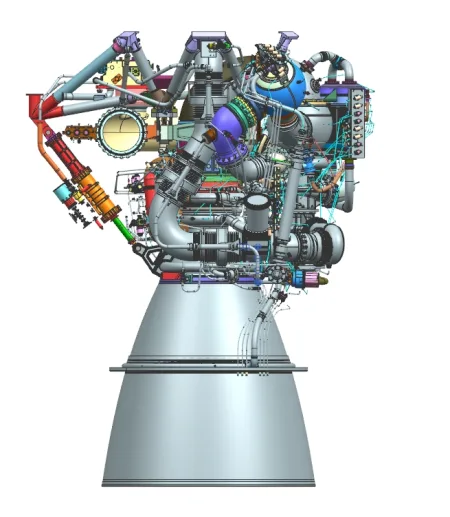
The Indian Space Research Organisation (ISRO) developed three indigenous cryogenic propulsion systems after the technology was blocked, Narayanan said. The agency that could not buy the engine built three of them.
Cryogenic propulsion is the hard part of heavy lift. Liquid hydrogen near minus-253 degrees Celsius, liquid oxygen, turbopumps under thermal stress that would shear ordinary hardware. The physics is unforgiving, which is precisely why it was the piece other powers were willing to deny.
The uncrewed Gaganyaan flight gates everything after it
ISRO's immediate priority is the first uncrewed Gaganyaan mission, scheduled for later this year. Only after reviewing that flight does the agency move to India's first crewed spaceflight. Review first, crew second.
A crewed vehicle inherits every unverified failure mode of the uncrewed one, so you fly the envelope empty before you fly it with people aboard. Narayanan said all major human-rating work for Gaganyaan is complete and the programme has entered flight validation, the most concrete signal in the whole address.
A space station by 2035, an Indian on the Moon by 2040
The long horizon is explicit. An Indian space station by 2035. An Indian astronaut on the Moon by 2040, carried there on an Indian-built launcher and not a borrowed one.
Chandrayaan-5 trades a 25-kg rover for a 350-kg one
Chandrayaan-4 becomes India's first lunar sample-return mission. Chandrayaan-5, flown jointly with Japan, deploys a 350 kg rover designed to work for close to 100 days on the surface, against the 25 kg rover on Chandrayaan-3 that lasted 14. Fourteen times the mass, seven times the endurance. That is not an iteration. It is a different class of mission.
ALSO READ:NASA picks SpaceX to deorbit the space station
The 200-tonne semi-cryogenic engine is the bottleneck to watch
Speaking to reporters afterward, Narayanan said ISRO's 200-tonne semi-cryogenic engine has reached nearly 90% of its required thrust and is being readied for testing. He set the agency's scale beside it: from a 7-kg sounding rocket in 1963 to more than 105 launch vehicle missions, 135 satellite missions, and 434 satellites flown for 34 countries. He credited the Indian Air Force and HAL for their work on Gaganyaan and the reusable launch vehicle, and noted ISRO's satellites performed during Operation Sindoor.
The engine is the quiet headline. A space station and a crewed lunar landing both need lift the current fleet does not deliver, and the semi-cryogenic engine is what closes that gap. Ninety percent of thrust is close. The last ten percent, on any propulsion system, is where the schedule actually lives.
What this means for anyone tracking whether the dates hold
The roadmap reads clean on a slide: 2035, 2040, sample return, joint rover. The honest read is that nearly all of it rides on propulsion India is still qualifying. The uncrewed Gaganyaan flight is the near gate. The semi-cryogenic engine is the far one. Both have to clear before the station and the Moon landing move from roadmap to manifest, and human-rating complete with flight validation underway tells you more than any date past 2030.
The pattern is the one Narayanan named himself. India spent the better part of two decades answering a cryogenic embargo with its own engine, and it is now running the same play one tier up build the heavy-lift propulsion no one will sell, then build the missions on top of it. Watch two results this year above the headline dates: the uncrewed Gaganyaan flight, and the semi-cryogenic engine's move from 90% thrust to a full-duration test fire. Those tell you whether the rest of the manifest is real.