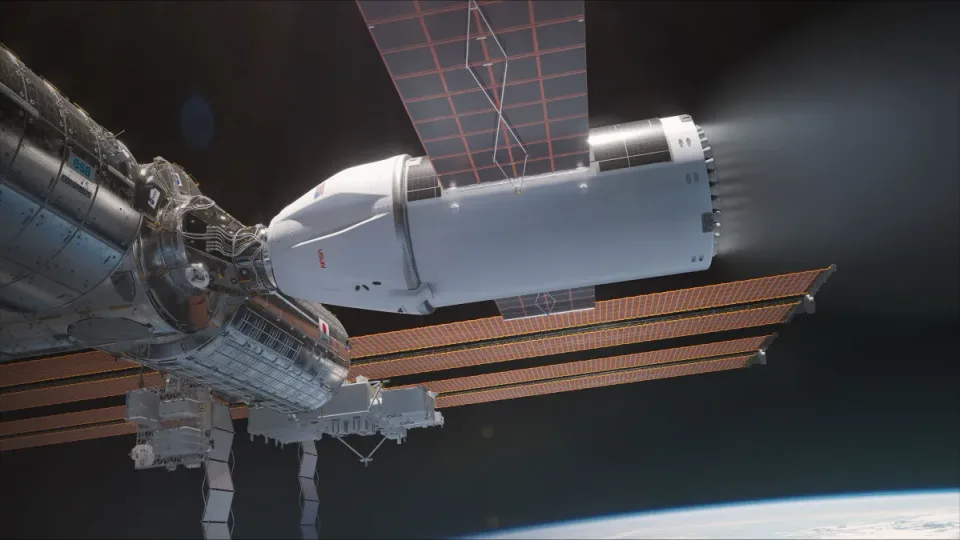
NASA is paying SpaceX up to $843 million to build a spacecraft that will fly exactly one mission: dock with the International Space Station, fire its engines for hours, and drag 430 tonnes of it into the Pacific.
The station has been continuously crewed since November 2000. Hundreds of astronauts, dozens of countries, more than three decades aloft by the time it comes down. In 2030, NASA will deliberately destroy the largest structure humans have ever assembled in orbit, and it has hired the company that resupplies that structure to build the machine that ends it.
Left alone, the station falls on its own
The ISS does not float in empty space. It orbits at the very top of the atmosphere, where a trace of air still drags on it, and that drag never stops. Trace air means friction. Friction means the station loses altitude, slowly, all the time. Only periodic reboosts hold it up, for years from Russian Progress freighters and more recently from Northrop Grumman's Cygnus cargo ships. Cut those, and within a year or two the station begins an uncontrolled tumble back toward the ground.
A 430-tonne uncontrolled reentry is not a thought experiment. Salyut 7 came down over South America in 1991 and scattered debris across populated areas. Skylab broke apart over Western Australia in 1979 and dropped pieces near Esperance (the town issued NASA a fine for littering). The ISS carries several times Skylab's mass. Its trusses, its docking adapters, the dense pressurised modules much of that survives the fire and reaches the surface, and without active control it could land anywhere the orbit passes over. That range covers most of the people on Earth.
So the deorbit is controlled, into the one place chosen for exactly this. Point Nemo, the most remote water there is, already holds the Russian Mir station, deorbited there in 2001.
What SpaceX is actually building
The U.S. Deorbit Vehicle (USDV) is a heavily modified Dragon. NASA's specification calls for far more propellant and power than a Cargo Dragon carries, which means the trunk-and capsule design gets a much larger propulsion section bolted to the back. Its engines have to burn for an extended stretch to push the station out of its parking orbit and onto a precise path down, timed so the breakup falls over open ocean and not over Auckland or Santiago. From the final burn to splashdown is a matter of hours.
The vehicle flies once.
Then it sinks to the bottom of the Pacific, along with whatever pieces of the station reach the surface intact. No recovery, no second flight, no reuse, which is an odd ending for a company built on landing and reflying everything it makes.
One detail is worth sitting on. NASA buys cargo and crew flights from SpaceX as a service and lets the company own and operate the hardware. For this mission it is not doing that. SpaceX builds and delivers the USDV, but NASA owns it and runs the flight. For the one job it cannot afford to get wrong, the agency is keeping the keys.
The launch will likely need a Falcon Heavy, because the USDV will be heavier than any Dragon ever flown.
Read More: Isar Aerospace to Launch Planet's German-Built Pelican Satellite
The $843 million is a floor, not a ceiling
The contract ceiling is $843 million. The mission costs more than that. Launch services, ground support, and the coordination with Roscosmos all sit outside the build contract, and the full operation runs past the headline number.
The comparison that matters is Mir. Russia brought its station down in 2001 for a small fraction of what the ISS deorbit will cost, and the gap is not waste. It is scale. The ISS is more than three times Mir's mass and far more complicated: truss segments, solar arrays the size of football fields, pressurised modules contributed by five space agencies and assembled across two decades of flights. You do not dispose of that the way you dispose of a single-agency station a third its size.
Boosting it to a graveyard orbit does not work
The obvious question, why destroy it at all, has reached Congress. In early 2026 the House Science Committee advanced a NASA authorisation bill that would force the agency to study lifting the ISS into a higher "storage" orbit instead of dropping it. The appeal is real. The station is a working monument to two decades of cooperation that survived the worst stretches of the US-Russia relationship.
The engineering is unsentimental. Pushing the station higher means firing engines against 430 tonnes of welded aluminium that was bolted together one module at a time, in orbit, and never designed to take a hard shove as a single rigid body. Each burn is a load the structure was never certified for. And the metal is already failing on its own: the Russian Zvezda module has been cracking and venting air for years, the trusses have ridden out thousands of thermal cycles, and the oldest modules are well past the lifetimes they were built to. Push hard enough to raise the orbit and you risk tearing the station apart in slow motion.
Bringing it home in pieces is worse. The modules were welded, bolted, and plumbed together by spacewalkers across hundreds of EVAs, many of those joints cannot be undone with any tool that exists, and no vehicle flying today could return even one module to the ground intact.
Congress calls it a monument. The engineers call it a structure that was never meant to be moved.
What this means for the people building what comes next
The hard part is not the demolition. It is the timing.
NASA wants out of the station operating business. It has funded several companies to build commercial successors and intends to rent research time on them rather than run its own outpost. The plan only works if at least one of those stations is flying before the ISS comes down, so the US does not lose its continuous human presence in orbit. None of them has flown a full station yet.
That is the exposure. The deorbit date is set partly by hardware that is already venting. Zvezda alone loses close to 2 kilograms of air a day, and NASA's own auditors flagged it as the highest safety risk aboard. The replacements, meanwhile, depend on development schedules. Anyone who watched Commercial Crew remembers how those go: after the Shuttle retired in 2011, the US bought Soyuz seats for nine years because the American replacement slipped and slipped again.
If the commercial stations slip the same way, the gap will not be quiet. China's Tiangong is up, crewed, and working. A deorbit that lands before a US replacement is ready would mean that for the first time since November 2000, the only humans living off Earth would be Chinese.
So the 2030 date has a soft side and a hard side, and they are not synchronised. The replacements can slip, the way replacements always do. The hardware cannot — a module that vents air does not wait for a schedule. The real value of the USDV is that it hands NASA the choice of when the station ends, rather than letting the structure decide. Watch the House storage-orbit study: it keeps the monument and the China argument alive on paper, but the leak rate and the thermal-cycle math will close it the same way the engineers already have. Expect the study to recommend what the deorbit contract already assumes.