Nova Systems has commissioned a satellite tracking ground station on Australia's Cocos (Keeling) Islands, handing India's Gaganyaan human spaceflight program telemetry and command coverage over the Indian Ocean that its mainland stations cannot reach.
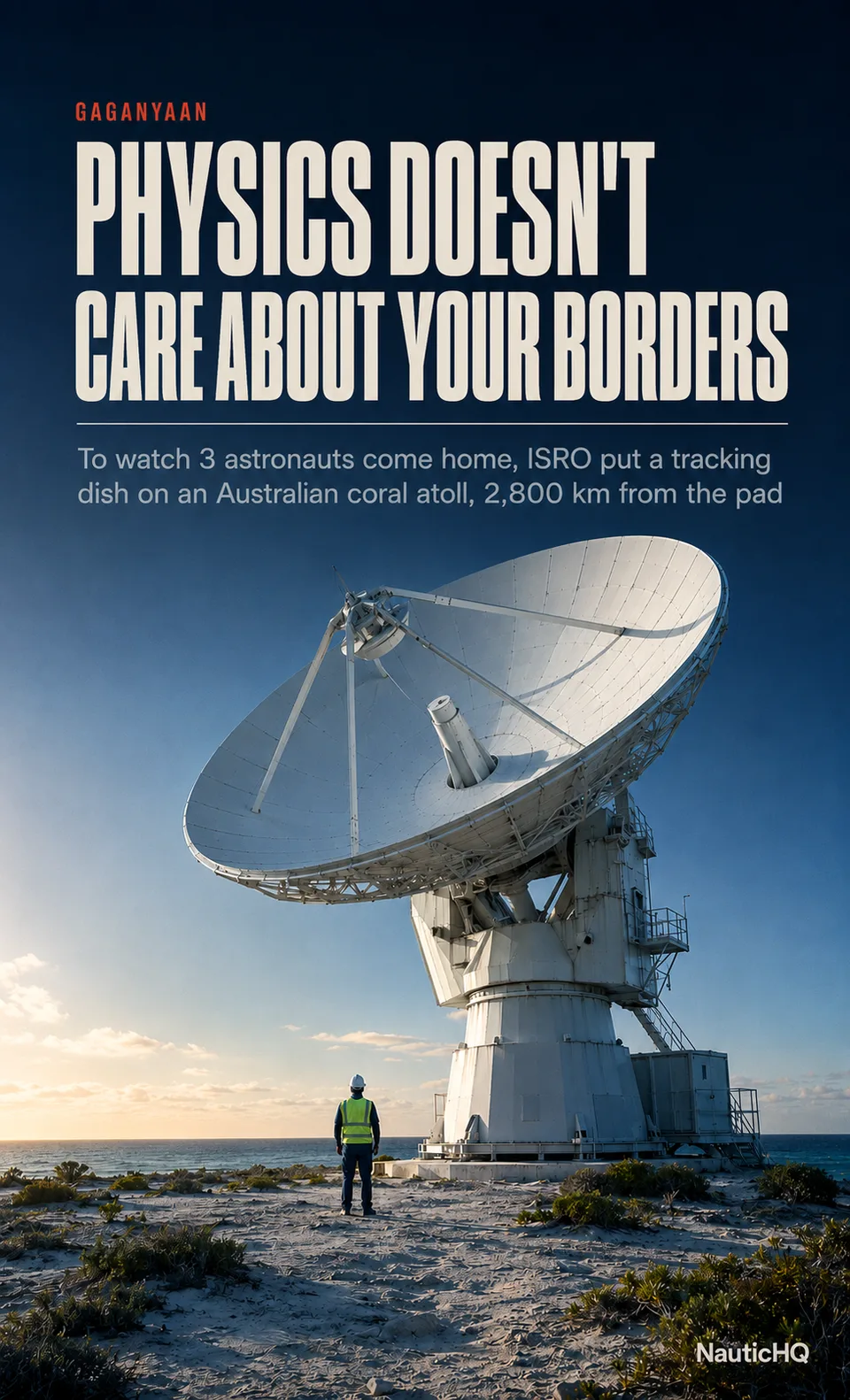
The commissioning was announced on 9 July at the third India–Australia Annual Summit in Melbourne, where Prime Ministers Narendra Modi and Anthony Albanese named the Cocos node among the summit's space outcomes. For India, it closes a physical gap in the tracking chain that has to be shut before three astronauts fly.
The station sits 2,800 km from Sriharikota, under the ascent path
The Cocos (Keeling) Islands ground station forms part of ISRO's Telemetry, Tracking and Command (TT&C) network, positioned about 2,800 kilometres southwest of the Sriharikota launch site in the eastern Indian Ocean. From there it watches the crew module climb out over the Bay of Bengal and, later, re-enter above the Indian Ocean ahead of splashdown in Indian waters.
The reason India needs the island is orbital geometry, not diplomacy. A crew module in a 400-kilometre orbit is in line of sight of a ground station only while it passes more or less overhead, and both the powered ascent and the re-entry arc for Gaganyaan run over open water that no Indian territory sits beneath. Cocos does.
The hardware got there the slow way. ISRO's S-band and C-band tracking antennas, several tonnes each, were shipped in by cargo vessel and assembled on-site an atoll with one airstrip and a small port is not a place you fly a dish into.
Nova Systems stays on as project manager, and the Navy backs the recovery
Nova Systems will remain project manager for the ground station through the coming mission phases, carrying project management, ground station engineering and spectrum management across the ISRO network. The Australian defence and engineering firm ran the commissioning in one of the more isolated places it is possible to put a tracking antenna.
The arrangement traces to an implementation agreement signed between ISRO and the Australian Space Agency in November 2024. That agreement did two things: it authorised the station at Cocos, and it committed the Australian Navy to help recover the crew module in an off-nominal splashdown because if a launch is aborted, the capsule is most likely to come down in Australian waters.
The Cocos Islands ground station joins a borrowed chain of 15-plus stations
Gaganyaan will lean on a global chain of more than 15 ground stations, and India owns only some of them. Similar tracking support runs through Fiji, French Guiana and the UAE, with contracted coverage from the Swedish Space Corporation and radio-frequency compatibility work done through a European Space Agency station in Germany.
Every agency that has flown humans has, at some point, rented someone else's horizon. A single orbit crosses more longitude than any one country's soil can watch, so continuous coverage during the phases where a crew is most exposed ascent, re-entry has always been a coalition exercise. That Cocos happens to be Australian territory in the eastern Indian Ocean, at a moment when Canberra and New Delhi are converging through the Quad, is lost on neither capital.
ALSO READ:India Builds 3 Cryogenic Engines, Plans 2035 Space Station
What this means for the mission chain
For the teams certifying Gaganyaan's mission assurance, the Cocos node removes one of the last coverage gaps standing between the current test campaign and a crewed flight. Tracking, telemetry and command across the re-entry arc is not optional for a human mission you cannot fly people through a blackout you chose.
The word doing quiet work in the official language is "temporary." India is building its own IDRSS relay-satellite network precisely so future crews can be tracked from orbit rather than from borrowed islands. Until that constellation is in place, the geometry holds: the uncrewed G1 flight expected this year, and the crewed mission after it, will both be watched in part from a coral atoll 2,800 kilometres from the pad. Watch whether the "temporary" terminal is still commissioned after the first crew comes home borrowed ground stations have a habit of outlasting the satellites announced to replace them