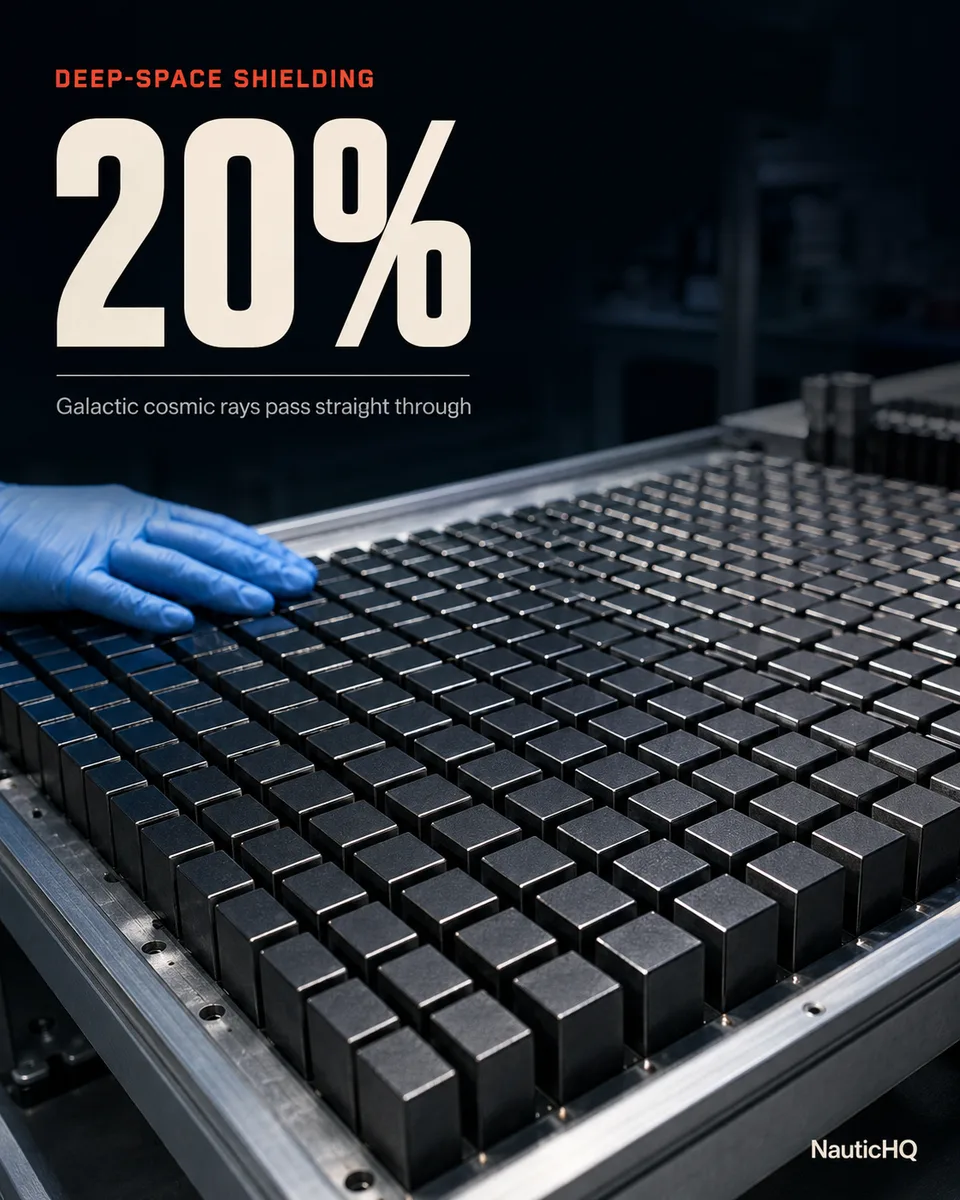
A permanent magnet radiation shielding array deflects about 20% of low-energy solar protons at under 300 kilograms and zero power draw, an Italian-German team reports and nothing at all against galactic cosmic rays.
The physics of getting a crew to Mars alive has not gotten easier. Two radiation sources threaten anyone outside Earth's magnetic field. Solar particle events (SPEs) are the intense proton bursts the Sun throws off during a storm. Galactic cosmic rays (GCR) are the thin, ceaseless rain of high-energy particles arriving from every direction at once. The first you can sometimes hide from. The second you cannot.
Permanent magnet radiation shielding trades protection for mass the rocket equation can afford
Valerio Parisi's team at Sapienza University in Rome built its assessment around 1,482 neodymium-iron-boron (NdFeB) magnets, each a three-centimeter cube, packed into a single square meter. The whole array weighs under 300 kilograms and draws no power. Against a collimated proton beam standing in for a solar storm, it turned aside roughly a fifth of the incoming particles in the 0.1 to 10 MeV range.
That mass figure is the entire point. Passive shielding the aluminum, polyethylene, and water shells flown today works by putting enough matter between the particles and the crew to absorb them, and enough matter to stop a serious SPE can run to tens of tonnes. The rocket equation punishes every one of those tonnes twice, once to lift the shield and again to lift the fuel that lifts the shield. In the SR2S era, engineers costed an extra kilogram on a deep-space mission at roughly $15,000. At that rate, a passive water shell is a line item that can sink a mission before it launches. A 300-kilogram magnet array is not.
The shield acts as a high-pass filter, and that is its ceiling
The magnets deflect the slow protons and wave the fast ones through a high-pass filter in everything but name. That 20% headline number is really a description of what the field does: it bends the low-energy particles hard enough to miss the craft and barely touches the high-energy ones. Push the proton energy up and the deflection falls away.
Which is why the array does nothing for the GCR problem. The field is directional, and it is weak. Galactic cosmic rays arrive from every angle with a proton flux that peaks near 1 GeV a hundred times past the energy this shield can turn. A magnetosphere is the existence proof that magnetic deflection can stop cosmic rays; Earth's does it every day, and Wernher von Braun proposed borrowing the trick for spacecraft back in 1969. The catch has always been field strength. Every few years a magnetic-shield paper promises to wrap a craft in its own magnetosphere, and the mass budget keeps saying no.
ALSO READ:China achieves Long March 10B booster recovery
Superconducting shields promise more, and cost far more
The EU's Space Radiation Superconducting Shield (SR2S) project spent years chasing the harder target a field strong enough to turn cosmic rays, not just solar ones. Its design wound magnesium diboride (MgB2) superconductor into a toroid meant to throw a field around 30,000 times stronger than Earth's, spanning roughly ten meters. On paper it does what the permanent magnets can't.
The bill comes due in cryogenics and power. A superconductor has to be held near absolute zero, which means continuous cooling, which means a continuous power supply for both the coils and the fridge. Kill either one a stray cosmic ray flips the wrong transistor and the shield collapses at the exact moment the crew needs it. SR2S wrapped up in December 2015 having proven the concept but reaching only technology readiness level 3 for the full system. Permanent magnets sidestep the entire failure mode: no power, no cooling, nothing to switch off. What they give up is the field strength that would matter most.
Secondary radiation and demagnetization are the quiet problems
The Parisi paper flags two failure modes a deflection field cannot design away: secondary radiation and slow demagnetization. When a proton does hit a magnet instead of missing it, the collision can spray out neutrons and gamma rays. Passive shields have the same defect protons slamming into aluminum induce their own secondary shower, which is part of why a few centimeters of aluminum stops protons only up to somewhere between 50 and 125 MeV before it starts making the problem worse. None of this turns an astronaut into the Hulk. It does mean a crew member in the wrong spot could catch a higher local dose than the raw numbers suggest.
Then there is time. NdFeB is the strongest permanent magnet in production, but it loses field slowly, and it loses it faster when it warms up. Over a multi-year mission, a shield that starts at full strength does not end there. A magnet that quietly weakens is a shield with a shelf life, and deep-space missions are measured in years.
What this means for a Mars-mission designer
NASA caps an astronaut's career radiation exposure at 600 millisieverts; a lightly shielded habitat on an 860 day conjunction-class Mars mission at solar maximum has been modeled at 1.01 sieverts nearly double the limit before anyone adds a margin. Deflecting a fifth of the low-energy solar slice does not close that gap. It was never going to.
So the honest way to read this paper is not as a shield but as a component. The value of a rugged, powerless, sub 300 kilogram array is as one layer in a stack a first filter ahead of a passive storm shelter the crew retreats to during an SPE, paired eventually with an active system for the GCR background. Some deflection is better than none, and this kind of deflection is cheap in the only currency that counts on a launch pad.
The team's next step is Monte Carlo modeling, to see how the array behaves in a chaotic, multidirectional field instead of against a tidy collimated beam. Expect that work to reposition the magnets not as a shield but as a stage the first cut in a layered system that still ends in mass, because a high pass filter that stops a fifth of the easy particles is exactly the role the mass budget leaves it, and no more.
FAQ
Does permanent magnet radiation shielding stop galactic cosmic rays?
No. The Parisi array only deflects low energy protons in the 0.1 to 10 MeV range and acts as a high-pass filter, letting high energy particles through. Galactic cosmic rays arrive isotropically with a proton flux peaking near 1 GeV, far beyond what this field can turn, so the shield does effectively nothing against them.
How heavy is the proposed magnet shield, and why does that matter?
The array of 1,482 NdFeB cubes weighs under 300 kilograms. Mass is the whole argument: passive shielding against a solar storm can run to tens of tonnes, and in the SR2S era an extra kilogram on a deep space mission was costed near $15,000, so a light shield with no power draw is economically attractive even at modest performance.
Why not just use superconducting magnets instead?
Superconducting designs like the EU's SR2S toroid can generate a field tens of thousands of times stronger than Earth's, strong enough to target cosmic rays. But they demand continuous cryogenic cooling and constant power, and the shield fails entirely if either is lost a risk permanent magnets avoid, at the cost of a far weaker field.