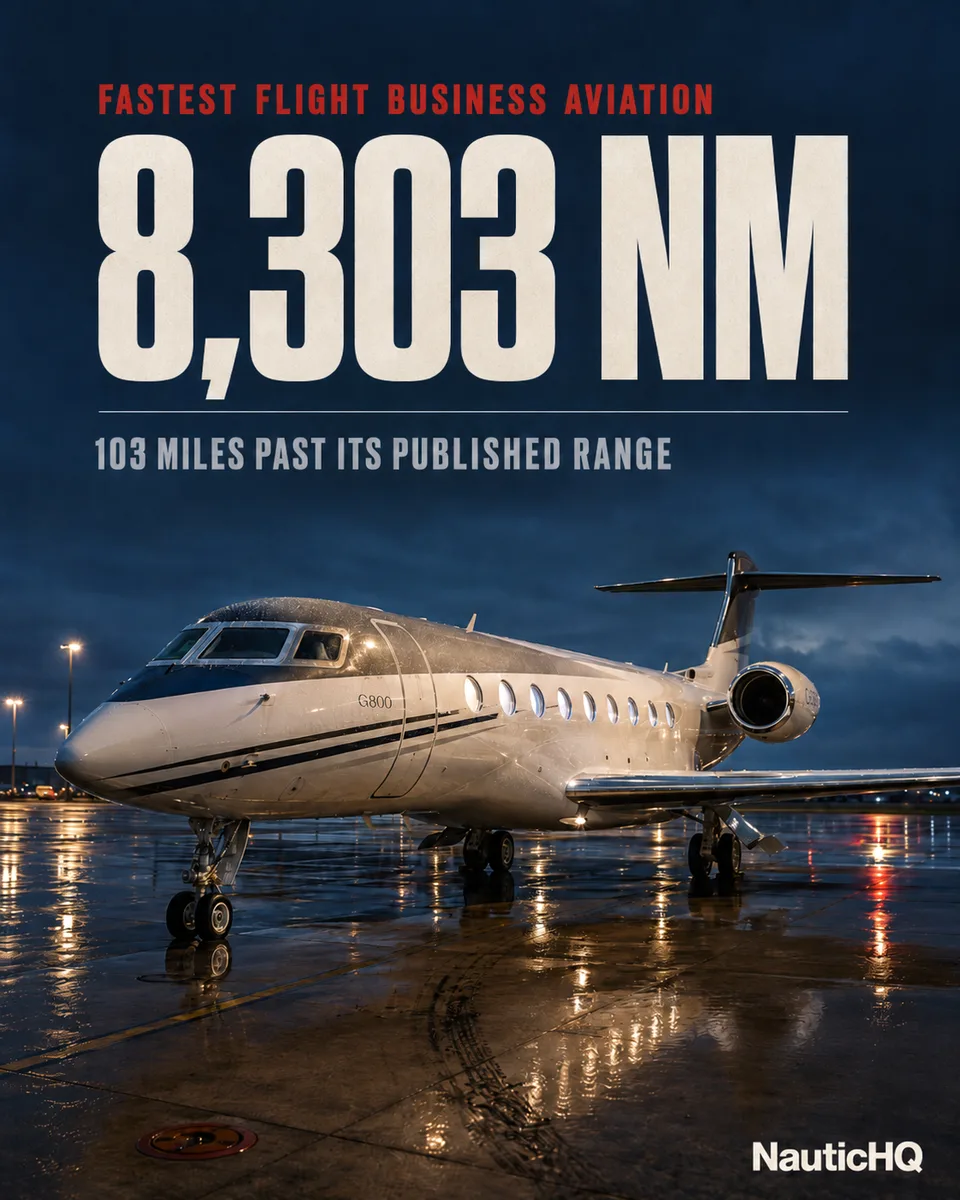
Gulfstream's flagship G800 logged the company's 800th city-pair speed record in June, then flew 8,303 nautical miles nonstop from Melbourne to Moline in 16 hours 56 minutes the farthest and fastest flight business aviation has recorded.
Both milestones landed less than a year after the aircraft entered service in August 2025, and Gulfstream announced them from its Savannah home base. At the top of the ultra-long-range market, where two airframers fight over a few dozen deliveries a year, records are how the fight gets narrated.
The 800th record came on a Reykjavik to Savannah run
The number-800 flight was the quiet one. A G800 left Reykjavik (RKV) for Savannah/Hilton Head (SAV), covered 2,973 nautical miles in 5 hours 52 minutes, and held an average cruise of Mach 0.91. That crosses the North Atlantic at a clip most business jets cannot sustain, and it booked Gulfstream's 800th officially recognized city-pair speed record.
The fleet tally now sits at 815. The G800 has supplied 15 of those since it entered service, which is quick accumulation for an airplane not yet a year old.
Melbourne to Moline beat the airplane's own published range
On June 28 the second flight did the thing that matters. A G800 ran from Melbourne (MEL) to Quad City International (MLI) in Moline, Illinois 8,303 nautical miles, 15,377 kilometers, 16 hours 56 minutes, average Mach 0.85.
Read the range card and that distance should not have happened. The G800 is published at 8,200 nautical miles at Mach 0.85. The Melbourne leg went 103 miles past it at the same speed. Favorable winds and a light load will do that, but the fact holds: the airplane flew farther than its own brochure, and Gulfstream called it the farthest and fastest flight in business aviation history.
A city pair record is a marketing instrument dressed as an engineering result. This one had the engineering under it.
ALSO READ:EasyJet Board Accepts Castlelake's £5.5bn Takeover Bid
The range card is the actual product
Speed and range trade against each other, and the G800's certification numbers show exactly where the trade sits. 8,200 nautical miles at Mach 0.85. 8,000 at Mach 0.87. 7,000 at a high-speed cruise of Mach 0.90. Maximum operating speed is Mach 0.935.
That top figure is the headline. The middle of the card is where the airplane earns its keep. Burn more fuel to go faster and the range shortens, so a buyer flying Singapore to the US east coast picks a point on that curve every trip: shave the hours at Mach 0.90 and land with thinner reserves, or hold Mach 0.85 and keep the diversion options open. The card is the product. The record flights just show its edges.
The cabin is built for the 16-hour mission
An airplane that can stay airborne for close to seventeen hours has to be livable for close to seventeen hours. Gulfstream holds the G800 cabin at 2,840 feet of pressure altitude while cruising at 41,000 feet, and cycles 100 percent fresh air through a plasma ionization system every two to three minutes. Sixteen panoramic oval windows carry the daylight.
Layout follows the buyer: up to four living areas, or three plus a dedicated crew-rest compartment for the legs that run well past sixteen hours. On a Melbourne to Illinois flight, that compartment is not a luxury. It is a duty time necessity.
What this means for fleet planners and buyers
For the flight departments and charter operators weighing the top of the market, the numbers that matter are not the 800 records. They are the 8,303 miles and the Mach 0.935 ceiling. Together they mean the G800 can connect city pairs that used to need a fuel stop, at nearly the speed of the aircraft still making that stop. On a specific and growing set of routes, that collapses the case for stopping at all. President Mark Burns tied the two milestones to Gulfstream's next-generation fleet, and the framing is fair the record and the range flight are two readings of the same airplane.
Records are the language the ultra-long-range top of market speaks, and Gulfstream now has 815 reasons to keep speaking it. Expect the G800's tally to climb through 2026 as demonstration crews chase the city pairs still open on the board, the ones with a marketing story attached and winds that cooperate. But the flight that moves the segment is the next one that beats a published range number on a route a customer actually flies every week. Watch for that one, not the round-numbered one.