Skyroot Aerospace completed India's first private orbital launch on July 18, 2026, when its four-stage Vikram-1 lifted off from Sriharikota and deployed its payloads 17 minutes later. India is now the third country with private orbital launch capability.
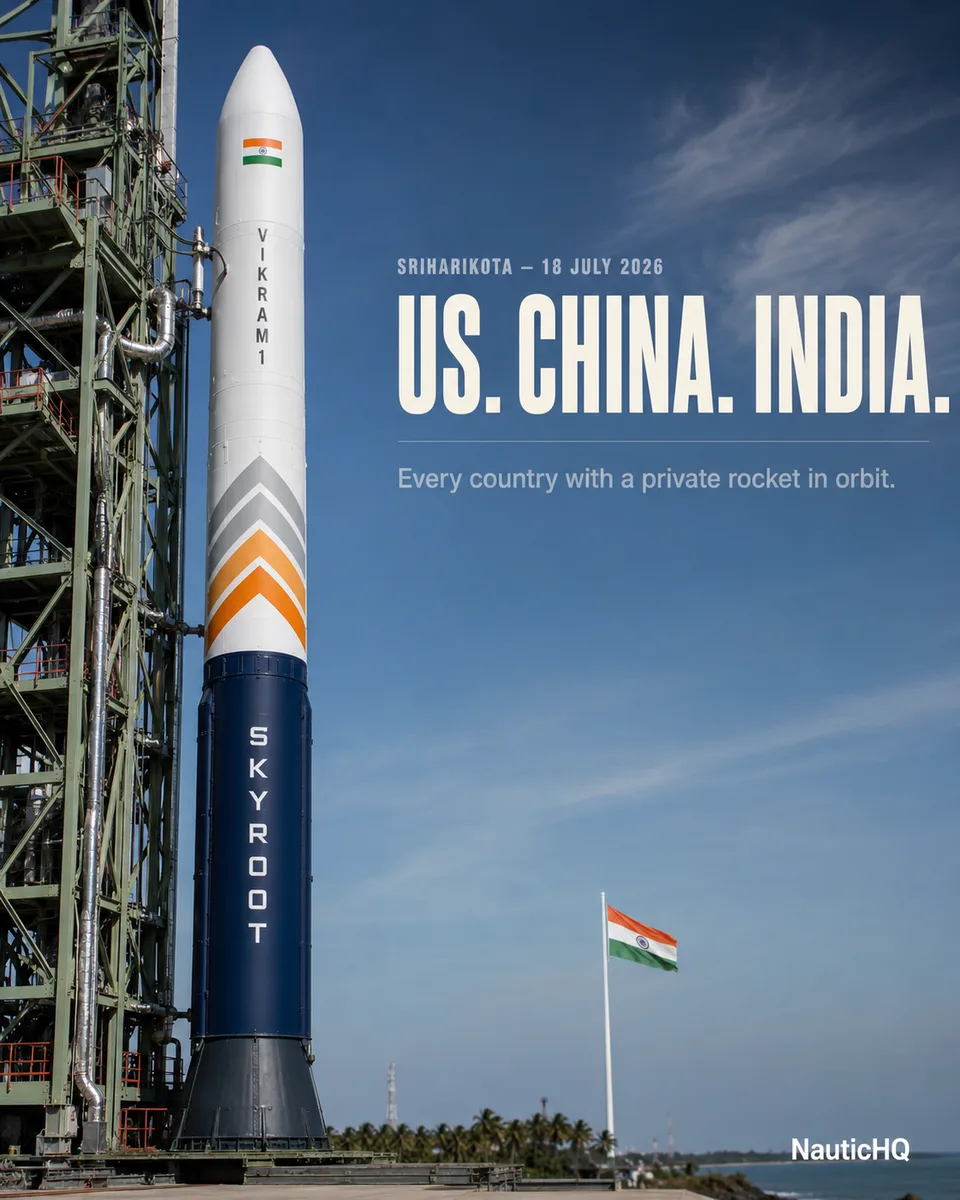
The other two are the United States and China. India opened its space sector to private operators in 2020, and the country now counts more than 400 space startups against a space economy of roughly $8.4 billion. Until July 18, none of them had put anything into orbit on a vehicle of their own.
Vikram-1 flew a nominal trajectory and cleared every mark inside 17 minutes
The rocket left the First Launch Pad at the Satish Dhawan Space Centre at 12:05 p.m. IST on a solid first stage. Vikram-1 stands about as tall as a seven-story building, runs four stages, and is rated to carry up to 350 kilograms to low Earth orbit. Skyroot said the vehicle held its planned trajectory and released its payloads on schedule. The mission carried the name Aagaman, designated Test Flight-1.
The manifest was half engineering, half statement. A lab-grown diamond. Robotic arms built for debris removal. An 18-karat gold miniature rocket carrying sculptures of Vikram Sarabhai, CV Raman and APJ Abdul Kalam.
A launch manifest is not usually also a national portrait gallery.
Sriharikota's previous outing had gone the other way. The PSLV C62 mission in January 2026 was lost to a third-stage anomaly.
Skyroot needed eight years and one suborbital flight to reach orbit
Skyroot was founded in Hyderabad in 2018 and flew Vikram-S in November 2022, a single-stage suborbital shot that reached 89.5 kilometres. That flight proved the company could build a motor and get range access. This one proves it can build a launch vehicle, which is a different problem entirely staging, guidance, and the orbital insertion accuracy a paying customer actually buys.
Pawan Goenka, who chairs the Indian National Space Promotion and Authorisation Centre, said the result ran well past what anyone expected from a first orbital attempt by an Indian private company. Former ISRO chairman K. Sivan described it as the "fruits of the seeds sown" when the sector was opened.
Every government says it wants a private launch industry. Far fewer hand over the pad.
ALSO READ:Nova Systems commissions Cocos station for Gaganyaan
The 350-kilogram class competes on schedule, not on price per kilogram
A dedicated small launcher does not win on cost per kilogram, and Skyroot is not pretending otherwise. Rideshare on a large vehicle spreads one launch across dozens of customers; a dedicated 350-kilogram vehicle spreads it across one. What the small launcher sells is the orbit you asked for, on the date you asked for, without waiting for an anchor payload to be ready. Constellation operators filling a specific plane pay for that. So do defence customers.
The economics underneath are simpler than they look. A launch company's cost sits mostly in fixed overhead: the team, the test stands, the range slot, the qualification campaign. Fly once a year and every flight carries the whole company. Fly six times and each carries a sixth. Cadence is not a performance metric here. It is the entire business model.
What this means for satellite operators and launch buyers
Nobody books a constellation off a single test flight, and no procurement officer should. What changed on July 18 is that operators now have a second Indian path to orbit to price against ISRO's [SSLV and PSLV rideshare] and, more quietly, proof that the IN-SPACe authorisation route works end to end, from licence to insertion.
The number to watch is not 350 kilograms. It is the gap between this flight and the next one. Skyroot is committed to Vikram-2 at 900 kilograms, and the range at Sriharikota is shared with ISRO's own manifest, which makes cadence a scheduling negotiation as much as a manufacturing one. Rocket Lab needed the better part of two years to get from Electron's first orbit to anything resembling routine flight. Expect serious commercial contracts to wait for flight two, and expect Agnikul to pull its own timeline forward now that someone else has gone first.