The United Kingdom will put £8.6 billion ($11.4 billion) into the Global Combat Air Programme (GCAP) over four years, clearing the way for a new Edgewing contract before Farnborough and holding the fighter to its 2035 date.
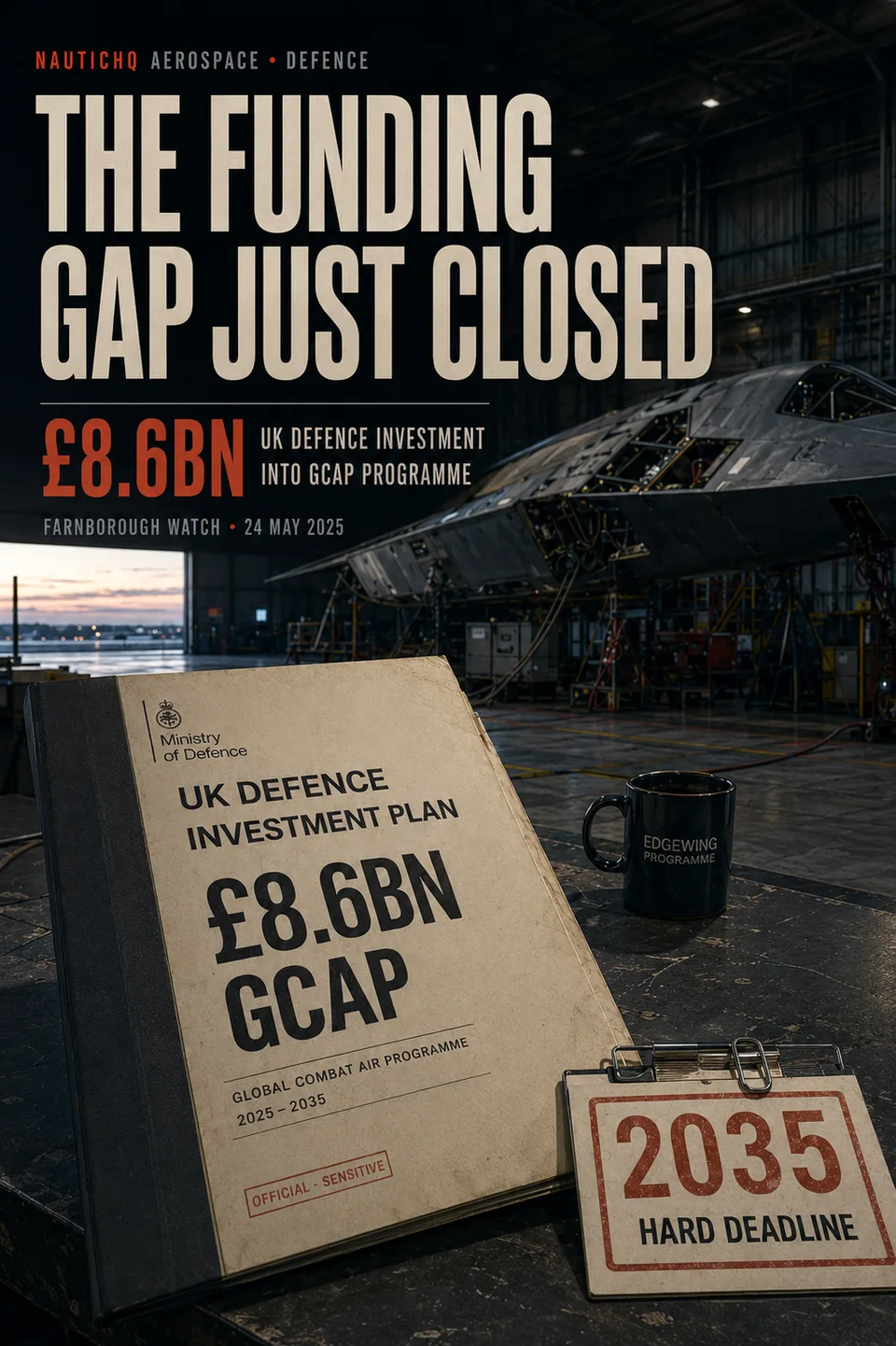
The money settles months of doubt. GCAP had been waiting on Britain's Defence Investment Plan, a spending roadmap first expected last year and pushed back repeatedly while ministers argued over where defense money should go. The plan is now out, and it carries the fighter the sixth-generation aircraft the UK, Italy, and Japan are building together for service by 2035.
The number came in above what the program expected
Analysts had penciled in roughly £6 billion. The £8.6 billion figure runs well past that, and the gap matters more than it looks.
A multinational fighter program is only as funded as its least-committed partner, and Britain had been the open question. So a larger than expected UK line does not just cover UK work. It tells Rome and Tokyo the biggest partner is not looking for the exit.
A £686 million bridge contract runs out this month
Earlier this year the GCAP Agency signed a temporary £686 million development deal a bridge, in plain terms, to keep engineers working while the UK sorted its long-term commitment. That bridge expires this month.
Without the new funding, the program faced a gap. A stop in paid work on a clean-sheet combat aircraft, mid-development, for no reason other than a budget document running late. The allocation closes that gap before it opens. Timing is most of the story here.
Edgewing turns the money into propulsion and electronics contracts
Once the new agreement is signed, Edgewing the consortium of BAE Systems, Leonardo, and Japan Aircraft Industrial Enhancement Co. Ltd. (JAIEC) is expected to push contracts down to the teams building the aircraft's propulsion system and its advanced electronics.
That is the practical meaning of the announcement. Money at the top becomes work at the sub-system level, where a fighter is actually built: the sensors, the networking, the engine.
ALSO READ:Isar Aerospace to Launch Planet's German-Built Pelican Satellite
What this means for the three partners
For anyone tracking GCAP as a program rather than a headline, the signal is coordination restored. The delay had done real damage Italy and Japan both wanted momentum, and reports had the uncertainty straining talks between the governments. That is the structural weakness of every joint program. No single nation can carry it, and any one of them can stall it. Britain's hesitation was a brake on all three, and removing the brake with more money than expected resets the partnership more effectively than any communiqué would.
Anyone who watched Eurofighter Typhoon grind through four nations' workshare and funding fights knows how these programs actually fail. Not on engineering. On commitment.
Watch Farnborough. The Edgewing contract is meant to be signed before the show, which makes the airshow the program's proof of life moment rather than a marketing set-piece. The harder constraint is the calendar 2035 is fixed, and a clean-sheet sixth-gen fighter has no slack to hand back a lost year. With the UK line settled above expectations, the next moves are close to scripted: Edgewing signs, the propulsion and electronics contracts follow, and Italy and Japan firm up their own commitments now that the largest partner has shown its hand. This program was never going to die in an engineering review. It could have died in a spending delay. This is the spending delay ending.