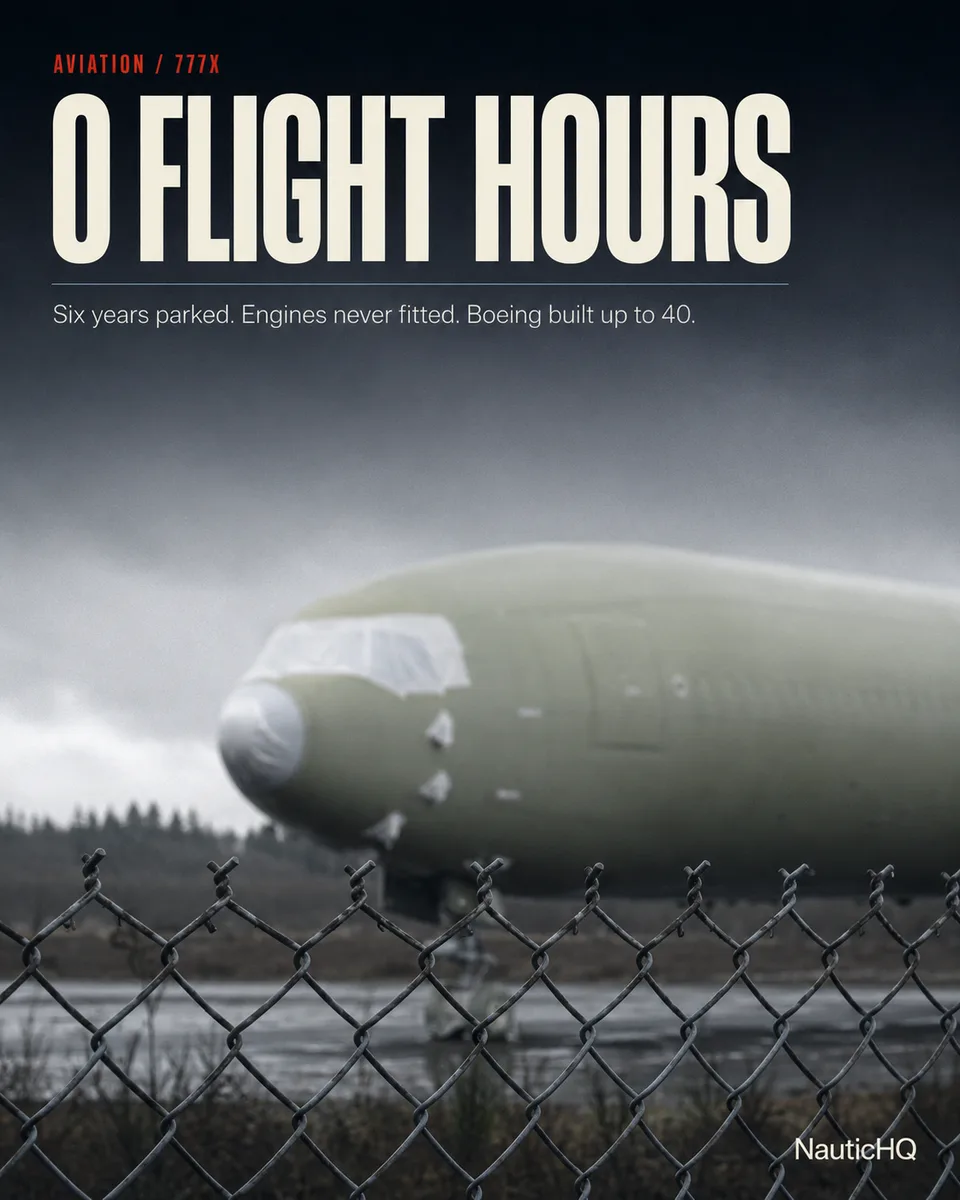
Boeing has broken up WH007, the seventh 777-9 ever built, after roughly six years parked at Paine Field. The airframe wore partial Emirates paint and never flew. It is the first airframe visibly lost to the 777X rework bill.
The program has absorbed $15 billion in charges, and the jets Boeing built ahead of certification are now the expensive part of that number. Every one of them has to be brought up to a design standard that did not exist when it was assembled. Boeing is deciding, airframe by airframe, which are worth finishing.
Boeing tore down the seventh 777-9 without ever fitting engines
WH007, line number 1611, rolled out of Everett in July 2019 and was allocated to Emirates as A6-EZT. Its folding wingtips were painted in Emirates colours. The rest of the structure stayed bare. Plane spotters photographed the aircraft with those wingtips removed within months of rollout, and no engines were ever hung.
The jet sat until Boeing disassembled it in the late summer of 2025. The manufacturer confirmed it had chosen not to complete one of its partially assembled 777-9s, said the aircraft had already been written off in earlier financial results, and declined to date the teardown. The Air Current reported it first.
Six years in the open, no engines, no flight hours.
Change incorporation is the price of building ahead of certification
Change incorporation is the retrofit work that brings an already built aircraft up to the final certified design. Findings from flight test, plus new Federal Aviation Administration (FAA) requirements, have to be applied to every airframe already sitting on the ramp. This happens on every new program. The 777X has run through more of it than most, because certification took longer than Boeing planned and kept generating changes while the factory kept producing.
The arithmetic is not complicated. An airframe finished to a superseded standard is not an aircraft, it is a structure that has to be opened up, reworked, and re-verified against a certification basis written after it was built. The older the build, the deeper the surgery. Boeing is believed to have built up to 40 airframes, and WH007 sat at the oldest end of that curve.
When Boeing still published list prices, a 777-9 carried a figure above $442 million. The company has not disclosed what change incorporation will cost across the built fleet. Somewhere on that curve the rework on an early jet costs more than a fresh line position, and the torch becomes the cheaper answer. WH007 was on the wrong side of it.
ALSO READ:Why Delta and Air Canada pay half for the Airbus A350-1000
Emirates has told Boeing it will not take stored aircraft
Emirates president Sir Tim Clark has made the carrier's position plain: it will not accept a stored 777X carrying that rework burden. Emirates holds 270 of the type on order, close to half of all passenger 777X commitments, and a customer with that share of the book does not need to file a formal rejection. Being known to be unwilling is enough.
At least one other carrier, unnamed, has also declined early-build aircraft. WH007 was the second 777X assembled for Emirates, behind WH006, line 1605, which is due to fly as A6-EZD. Boeing describes the outcome as a decision not to complete a partially assembled jet. Emirates had already made completing it pointless.
The 777X rework repeats the 787 Terrible Teens
Boeing has run this play before. The earliest 787s, the "Terrible Teens," needed years of rework, were eventually sold at steep discounts, and some never entered service at all. Earlier in 2026 a 787-8 with 13 hours of total flight time was broken up at Roswell Air Center in New Mexico.
Anyone who watched those airframes move through Charleston will recognise the shape of this. The 777X was meant to enter service in 2020 and is now scheduled for 2027 with Lufthansa as launch operator. Seven years of slip, and a factory that never stopped.
What this means for fleet planners and lessors
A stored 777X has no defensible residual value until its configuration standard is known, because nobody outside Boeing can price the rework attached to it. That makes early line numbers a liability rather than an asset, and it means the delivery stream will not run in build order. Lessors and finance desks looking at 777X paper should be asking which airframe, not which position in the queue.
Boeing is locked in on both sides. Emirates will not take the stored jets and cannot be replaced as a customer, and Lufthansa's 2027 date is now the credibility marker for the whole program. Expect more of the earliest line numbers to be written off rather than reworked, and expect the first deliveries to Lufthansa and Emirates to come from later build positions, not from the aircraft that have been sitting at Everett since 2019. Watch the line numbers on the first handovers. They will tell you how far up the curve the rework actually stopped making sense.